






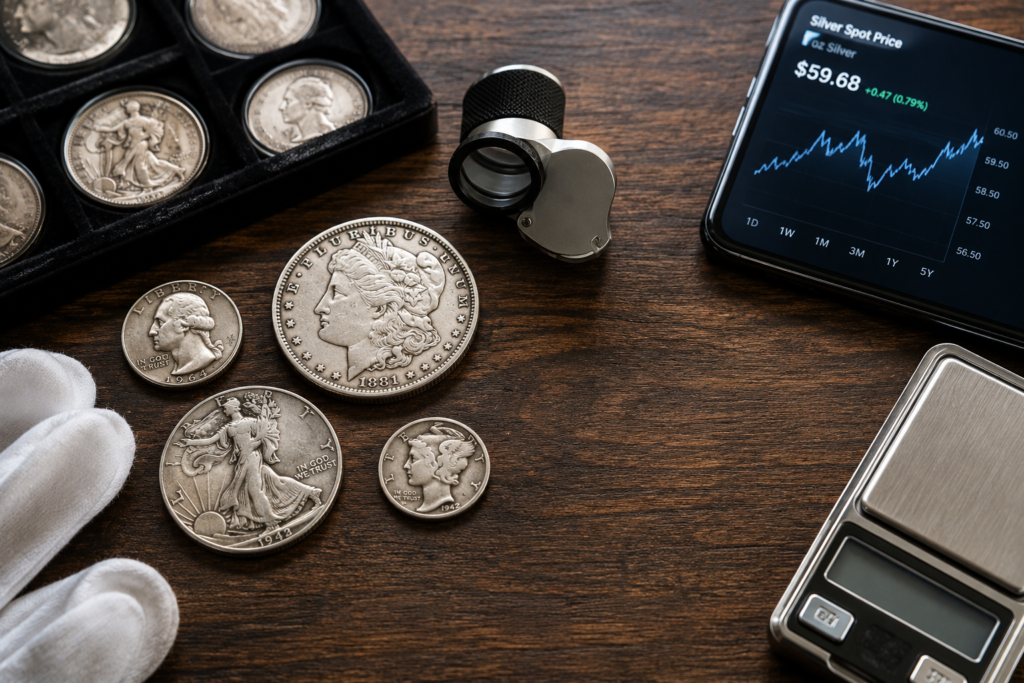
Before you sell a single coin, it pays to know exactly what you’re holding. Some old coins are worth nothing more than their silver content — often called melt value — while others carry a hidden collector’s premium worth ten, fifty, or even a hundred times more. The difference almost always comes down to four things: the date, the mint mark, the condition, and how rare that exact combination really is.
This guide breaks down how to check silver coin value the right way, how spot price sets the floor under every coin, how to read mint marks and grading, and which free coin appraisal tools actually work. It’s part of our Used Items Guide series on getting the most cash for things you no longer need — including precious metals sitting in a drawer.
Silver has stayed one of the most talked-about assets in the US through 2026, and a lot of households are realizing the coin jar in the closet might be worth real money. Here’s how to check before you sell.
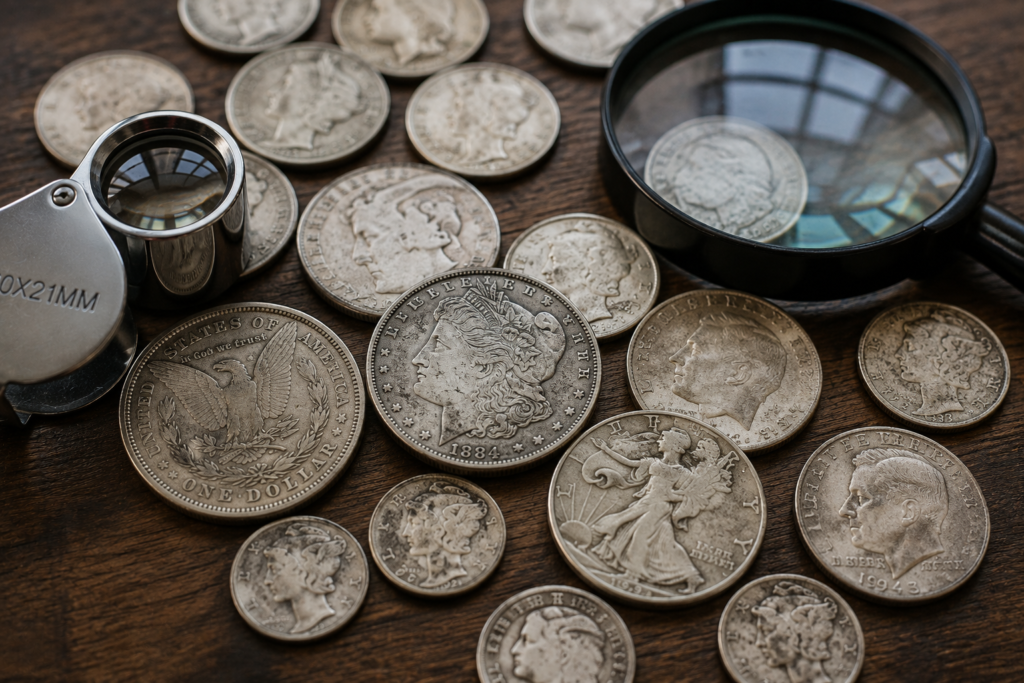
Silver Coin Value Kaise Check Karein: The Step-by-Step Process
Checking a coin’s value isn’t guesswork once you follow the right order. Work through these steps before you contact any buyer.
1. Identify the Coin
Note the denomination, the date, and the mint mark (the small letter near the date). Two coins that look nearly identical can be worth wildly different amounts once you factor in where and when they were struck.
2. Confirm the Composition
Most pre-1965 US dimes, quarters, and half dollars are 90% silver. Nickels from 1942–1945 (“war nickels”) are 35% silver. Sterling silver items are 92.5% pure, while bullion rounds and bars are usually 99.9% fine. If a coin doesn’t match a known silver-era date, check for a “S” mint mark or weigh it against known specifications before assuming it’s silver at all.
3. Check the Current Spot Price
Spot price is the live market price for one troy ounce of silver. It changes throughout the trading day, so check it right before you sell rather than relying on a number from last week.
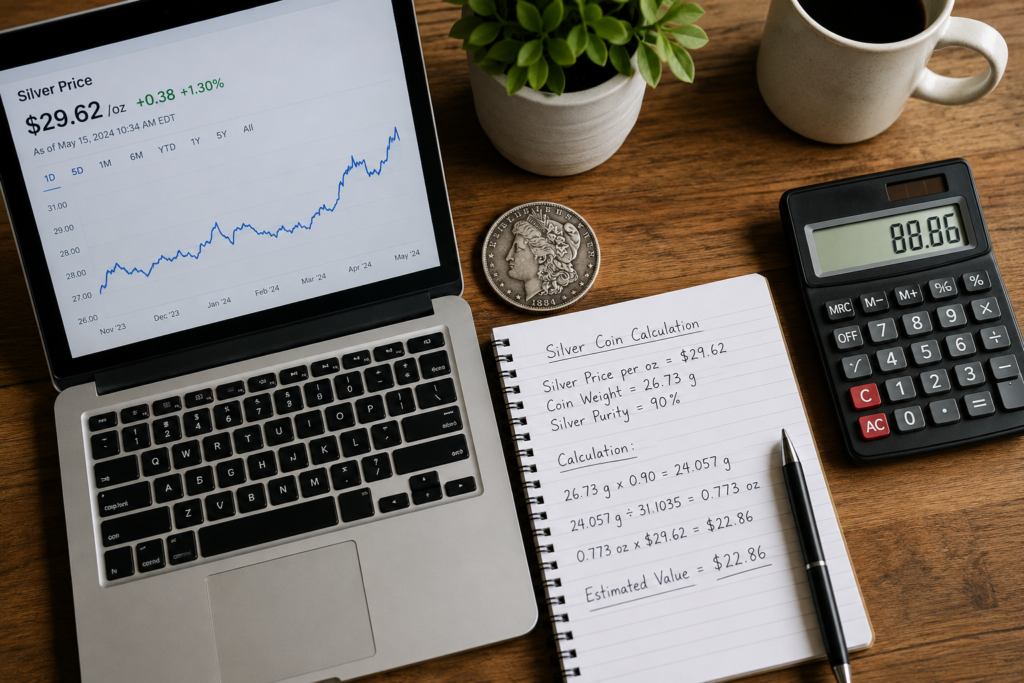
4. Calculate the Melt Value
Multiply the coin’s silver weight (in troy ounces) by its purity, then multiply that by the current spot price. This gives you the coin’s floor value — the absolute minimum it should be worth, regardless of collector interest.
5. Research the Numismatic Premium
Search the coin’s exact date, mint mark, and condition to see whether it’s a common date or a recognized “key date.” Key dates and low-mintage years can sell for many times their melt value.
6. Cross-Check Recent Sold Prices
Current asking prices on marketplaces are unreliable — sellers can list coins for whatever they want. Sold and completed listings show what buyers actually paid, which is a far more honest number.
7. Get a Second Opinion on Anything Unusual
If a coin looks old, has an unusual color, or doesn’t match any date you can identify, it’s worth a free in-person look from a local coin shop before you sell it anywhere. Once you know what you’re holding, our guide to the best places to sell old silver coins for cash compares every major buyer side by side, from local dealers to national bullion platforms.
Understanding Spot Silver Price (The Floor Under Every Coin)
Spot price is the benchmark trading price for raw, unminted silver, quoted per troy ounce. It’s set by global commodity markets and moves constantly during trading hours. As of mid-2026, silver has been trading in the high $50s to low $60s per troy ounce, well above where it sat just a couple of years earlier. You can track live pricing anytime through JM Bullion’s silver price chart, which updates throughout the trading day.
Spot price matters because it’s the baseline every legitimate buyer starts from. A reputable dealer calculates an offer by taking the spot price, multiplying it by your coin’s weight and purity, and then applying a percentage based on that coin’s form. If a buyer can’t explain how they arrived at a number, that’s a red flag worth walking away from.
The Melt Value Formula
● Weight (in troy ounces) × Purity percentage × Current spot price = Melt value
Example: a 90% silver quarter weighs about 0.1808 troy ounces of pure silver. At a spot price of $58 per ounce, that single quarter carries roughly $10.49 in melt value alone — many times its 25-cent face value, before any collector premium is even considered.
What Pushes a Coin Above Its Melt Value
● Rarity: low original mintage or few known survivors in collectible condition
● Condition: sharp details and original luster grade higher and sell for more
● Collector demand: some series are simply more sought-after than others
● Historical significance: first-year issues, errors, and notable dates carry a premium
Rare vs. Common Coins: What Actually Moves the Needle
Two coins from the same series and similar wear can have completely different values once mintage numbers and survival rates come into play. Here’s what separates a common coin from a genuinely valuable one.
Series Worth a Closer Look
● Morgan and Peace Silver Dollars (1878–1935): 90% silver with strong collector demand; certain dates like the 1893-S can be worth thousands.
● Mercury Dimes and Walking Liberty Half Dollars (1916–1947): Popular designs, with full-band or full-bell examples bringing strong premiums in high grade.
● Standing Liberty Quarters (1916–1930): The 1916 first-year issue is one of the most valuable regular-issue US coins ever struck.
● Wheat Pennies (1909–1958): Mostly common, but key dates like the 1909-S VDB regularly sell for hundreds even when worn.
This is only a starting list. For a full breakdown of key dates, mint errors, and where to actually sell coins that turn out to be rare, see our companion guide on where to sell rare coins online and locally in the US, which covers auction houses, online marketplaces, and local dealers in detail.
A simple rule of thumb: if a coin’s date-and-mint combination is uncommon, or the coin is in noticeably better condition than most surviving examples, it’s worth researching separately rather than lumping it into a bulk melt-value sale.
Mint Marks: The Fastest Value Clue on Any Coin
A mint mark is a small letter stamped near a coin’s date that shows which US Mint facility produced it. It’s one of the fastest ways to tell whether a coin is common or scarce, because the same date can be worth wildly different amounts depending on where it was struck.
Common US Mint Marks
● P — Philadelphia (often no letter at all on older coins)
● D — Denver
● S — San Francisco
● CC — Carson City (historic, found only on older coins)
● O — New Orleans (historic, found only on older coins)
Certain year-and-mint combinations, known as “key dates,” are worth far more than the rest of their series. A 1916-D Mercury dime, for example, is worth hundreds of times more than a common-date dime from the very same year struck elsewhere. Always check the mint mark before assuming a coin’s value based on the date alone.
[IMAGE PLACEHOLDER — Mint mark close-up]
Image generation prompt: Macro close-up photograph of a vintage silver coin held between two fingers, focus sharply on the small mint mark letter near the date, blurred neutral background, soft studio lighting, high-detail realistic photo.
Coin Grading 101: How Condition Changes the Price
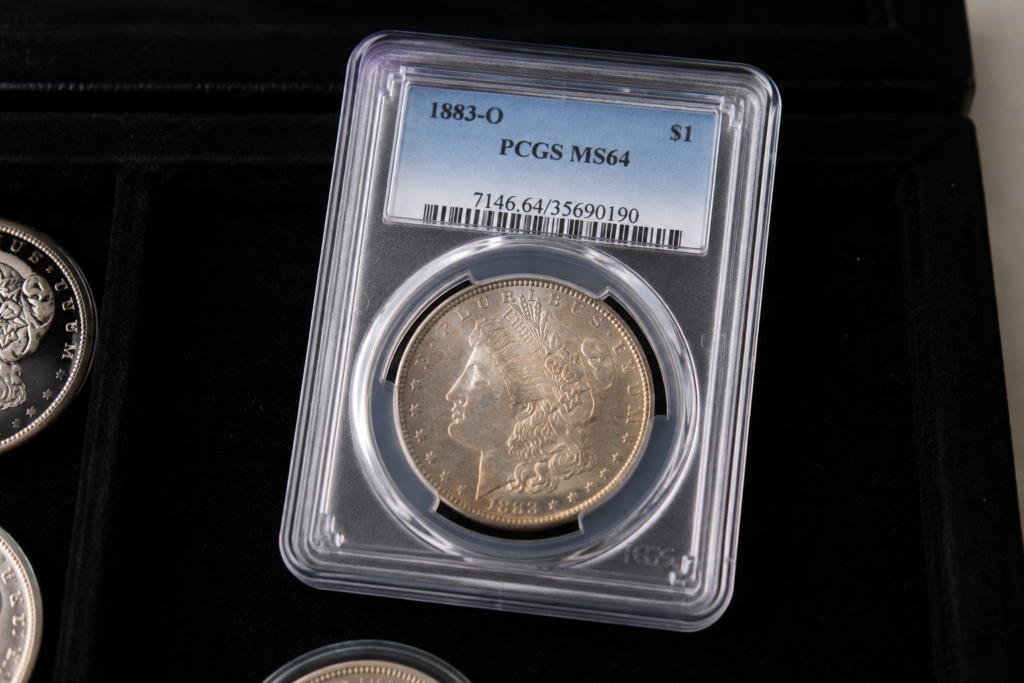
Condition, or “grade,” affects a coin’s value more than almost any other factor besides rarity itself. Professional grading services score coins on a 1–70 scale, then seal them in a tamper-proof holder with that official grade printed on it.
Raw vs. Graded Coins
● Raw (ungraded): Sold as-is, based on the seller’s or buyer’s own condition assessment. Faster and cheaper, but buyers may discount the price to cover their risk.
● Graded and certified: Authenticated and scored by a third party, which removes buyer guesswork and typically raises the final sale price for anything above common-date status.
The two most trusted grading services in the US are PCGS and NGC. Both publish free population reports and price guides, so you can research a coin’s likely grade and market value before deciding whether grading fees make sense.
When Grading Is Worth the Fee
● The coin is a known key date or a low-mintage variety
● You suspect it’s worth $150 or more in raw condition
● You plan to sell through an auction house rather than a local dealer
● The coin shows a possible mint error or variety needing authentication
When to Skip Grading
● The coin is a common date worth mostly its melt value
● Grading fees, typically $20–$50 per coin plus shipping, would eat most of its value
Free Coin Appraisal Tools You Can Use Today
You don’t need to pay anyone to get a solid first estimate. These free resources cover most of what a paid appraisal would tell you.
● PCGS CoinFacts: Free price guides and population data broken down by date, mint mark, and grade.
● NGC Price Guide: Similar coverage from the other major grading service, useful for cross-checking PCGS numbers.
● eBay Sold Listings: Filter for “Sold” or “Completed” listings on your exact date, mint mark, and condition to see real recent sale prices, not just asking prices.
● Local Coin Shop Walk-In: Most shops will give a free, informal estimate on the spot, especially if you’re not asking them to buy right away.
● American Numismatic Association: Educational resources on mint marks, grading, and spotting counterfeits, useful if you’re new to coin collecting entirely.
A Simple Silver Coin Price Calculator You Can Do by Hand
If you’d rather skip an online calculator, the math takes under a minute per coin:
● Step 1: Look up your coin’s silver weight in troy ounces (widely published for standard US coins).
● Step 2: Multiply that weight by its purity (0.90 for most pre-1965 silver coins).
● Step 3: Multiply the result by today’s spot price per troy ounce.
● Step 4: Add a premium if your research shows the coin also has collector demand.
This gives you a realistic floor value in under a minute, and it’s the same math every legitimate dealer uses to build their offer. For a full comparison of who pays closest to that number, see our guide on the best places to sell old silver coins for cash.
Documenting Your Coins Before You Sell
Whether you’re selling one coin or an inherited collection, a few minutes of documentation makes every conversation with a buyer faster and gets you a more accurate offer.
Sort First, Research Second
● Separate coins by type: silver dollars, dimes, quarters, half dollars, and anything unusual or foreign.
● Set aside anything with a date before 1965, since that’s the cutoff for circulating US silver coinage.
● Pull out anything that looks different from the rest of the pile, even if you can’t identify why yet.
Photograph and Weigh Before You Contact a Buyer
● Take clear, well-lit photos of both sides of any coin you suspect is valuable.
● Weigh coins in grams or troy ounces if you have a small kitchen or jeweler’s scale.
● Keep a simple list: date, mint mark, and condition notes for each coin worth a second look.
This documentation does two things: it lets you get quotes from multiple buyers without repeating the identification work each time, and it gives you a paper trail if you ever need to dispute an offer or insure a shipment.
Best Time to Check a Coin’s Value
Because silver is a traded commodity, the same coin can be worth noticeably more or less depending on the week you check. A few habits help you avoid selling at a temporary low point.
● Track the trend, not a single number: Watching spot price for even a few days shows whether it’s climbing, falling, or holding steady, which is more useful than one snapshot.
● Recheck before every sale, not just once: Silver can move meaningfully in a single trading day, so a value you calculated last week may already be outdated.
● Separate melt-value timing from collector-value timing: Numismatic premiums move far more slowly than spot price, so there’s rarely a rush to sell a genuinely rare coin the moment silver dips.
Quick Reference: Silver Coin Value Checklist
| Check | What to Look For |
| Date | Pre-1965 for most circulating US silver coins |
| Mint mark | P, D, S, CC, or O near the date; key dates worth more |
| Composition | 90% silver (dimes/quarters/halves), 35% (1942–45 nickels), or 92.5% (sterling) |
| Condition | Sharp details and original luster grade higher |
| Spot price | Check live, right before selling, not from memory |
| Sold listings | Confirms real recent prices, not just asking prices |
| Second opinion | Get one for anything unusual or possibly rare |
Common Price Mistakes to Avoid
● Cleaning or polishing coins: This feels intuitive but strips original surface and can cut a coin’s value by half or more. Never clean a coin you haven’t already identified as plain melt-value silver.
● Assuming “old” automatically means “valuable”: Age alone means very little. A common 1940s dime and a rare 1916-D dime look almost identical to an untrained eye.
● Ignoring the mint mark entirely: Skipping this single check is the most common reason sellers under-price a valuable coin.
● Accepting the first offer: Prices can vary more than sellers expect between buyers. Always get two or three quotes.
● Trusting an online calculator blindly: Automated tools are a good starting point but rarely factor in collector premiums. Cross-check with sold listings before finalizing your expectations.
● Not separating silver from silver-plate: Silver-plated items look similar but carry almost no melt value. A magnet test and a purity stamp check (“.925” or “Sterling”) take seconds and prevent an embarrassing mix-up.
Frequently Asked Questions
How much are old silver coins worth?
It depends on the coin’s weight, purity, and current spot price for the melt-value floor, plus any collector premium tied to rarity and condition. A single 90% silver quarter typically carries several dollars in melt value alone at current 2026 spot prices, before factoring in any collectible premium.
What’s the fastest way to get a coin appraisal?
Check the date and mint mark, then search that exact combination on PCGS CoinFacts or NGC’s price guide, and cross-check against eBay’s sold listings. This gives a reliable estimate in minutes, entirely free.
Is there a reliable silver coin price calculator?
The most reliable method is the manual formula: weight in troy ounces × purity × current spot price. Several bullion dealer websites also offer built-in melt-value calculators, but they only estimate metal content, not collector value.
How can I tell if my silver coin is rare?
Check the date and mint mark against known key dates for that series, note the condition, and compare against recent sold prices. A coin that’s scarce for its date-and-mint combination, or unusually well preserved, is worth researching individually rather than selling in bulk.
Should I get my coin graded before selling it?
Only if you believe it’s worth $150 or more raw, or if it’s a known key date or possible error coin. For common-date coins worth mostly melt value, grading fees usually cost more than the value they add.
Do banks buy old silver coins?
No. Banks accept coins only at face value regardless of silver content or rarity, so a valuable coin would be treated the same as ordinary change. Always sell to a dealer, appraiser, or collector instead.
What’s the difference between melt value and numismatic value?
Melt value is what a coin’s raw silver content is worth at the current spot price, with no premium for rarity. Numismatic value is what collectors will pay above that floor for a coin’s rarity, condition, and demand. A common coin usually sells close to melt value, while a key date can sell for many times more.
Can I check a coin’s value without an appraisal fee?
Yes. Free tools like PCGS CoinFacts, NGC’s price guide, and eBay’s sold listings cover most common US silver coins. Paid appraisals are only worth it for coins you already suspect are unusually rare or high-grade.
Final Thoughts
Spotting a valuable old silver coin comes down to slowing down before you sell: check the date and mint mark, understand today’s spot price, judge the condition honestly, and cross-check anything unusual against sold listings or a trusted grading service. Most coins in a jar or collection will land close to melt value, and that’s fine. The point of this process is catching the exceptions before they get sold for pocket change.
Once you know what you’re holding, the next step is finding the buyer who’ll pay closest to that number. Our full comparison, Best Places to Sell Old Silver Coins for Cash, walks through local dealers, national bullion buyers, pawn shops, and online marketplaces side by side, so your research here turns into the best possible payout.
