







A queen mattress is the best selling bed size in the US for good reason, at 60 by 80 inches, it gives a couple enough room to sleep comfortably without demanding the extra floor space, frame cost, and bedding expense of a king. Whether you’re searching for a queen mattress for a first apartment, a queen size mattress to replace one that’s sagging after a decade of use, or you keep seeing “mattress queen” and “queen bed mattress” in your search results and want a straight answer on what to actually buy, this guide covers everything: the best queen mattresses of 2026 by category, how the different mattress types actually differ, how to pick firmness and support based on how you sleep, and the buying details trial periods, certifications, delivery, that most shopping guides gloss over.
We’ll also cover a question most mattress guides skip entirely: whether buying a used queen mattress ever makes sense, and when it genuinely doesn’t. This guide is part of our broader site covering smart buying decisions for both new and secondhand goods.
Quick Picks: Best Queen Mattresses of 2026
If you don’t want to read the full breakdown, here’s the short version. Every pick below is covered in more detail further down this guide.
- Best Overall: Helix Midnight Luxe — hybrid, medium firmness, strong edge support, works for most sleep positions
- Best Budget: Nectar Classic — memory foam, under $600 for queen, long trial period
- Best for Couples: Bear Elite Hybrid — excellent motion isolation and cooling
- Best for Side Sleepers: Helix Midnight Luxe or Amerisleep AS3 — pressure relief at the shoulders and hips
- Best for Back Pain: Saatva Classic — adjustable firmness options and strong lumbar support
- Best Cooling / Hot Sleepers: Brooklyn Bedding Aurora Luxe — cooling cover and gel-infused foam
- Best Organic: Avocado Green Mattress — natural latex and certified organic materials
- Best Luxury: Stearns & Foster Reserve — hotel-style comfort with premium materials
- Best for Heavy Sleepers (230+ lbs): Titan Plus Luxe or Amerisleep AS3 — reinforced support cores
- Best Value Hybrid: Amerisleep AS3 — plant-based foam, zoned lumbar support, 20-year warranty
Queen Mattress Dimensions & Room Requirements
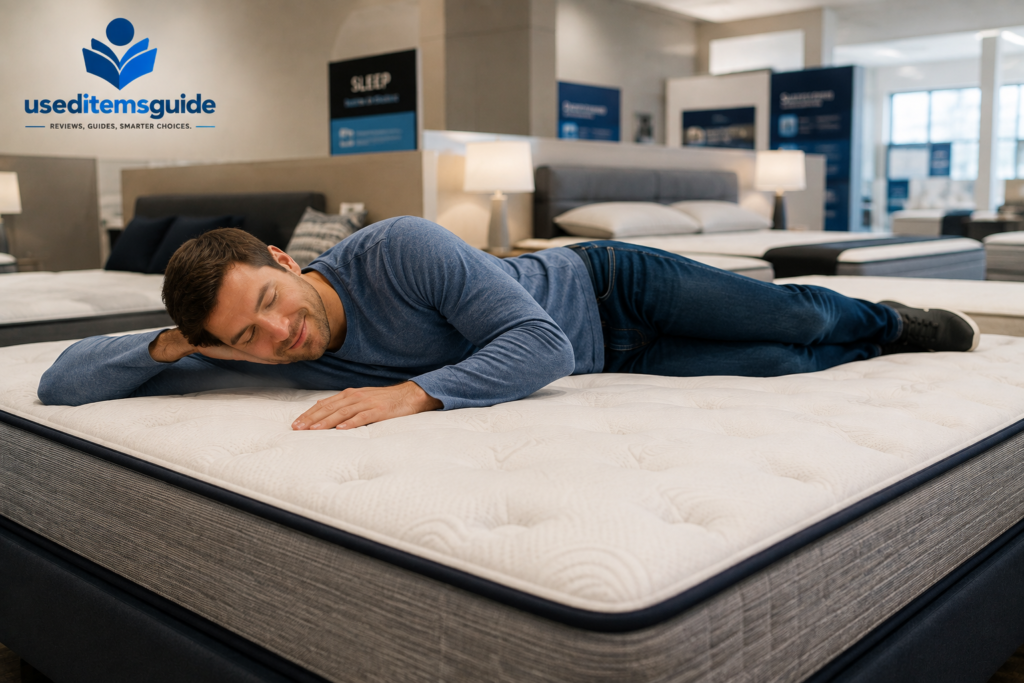
A standard US queen mattress measures 60 inches wide by 80 inches long, 5 feet by 6 feet, 8 inches. That’s the size regardless of brand or mattress type; “queen” is a standardized dimension across the entire US mattress industry, so a queen mattress from any manufacturer will fit any queen bed frame.
| Mattress Size | Dimensions (inches) | Best For |
| Twin | 38 x 75 | Single sleeper, kids’ rooms, small spaces |
| Twin XL | 38 x 80 | Single adult, dorm rooms (5 inches longer than Twin) |
| Full (Double) | 54 x 75 | Single sleeper who wants more room, occasional guest bed |
| Queen | 60 x 80 | Couples, single sleepers who like extra space |
| King | 76 x 80 | Couples wanting maximum space, larger primary bedrooms |
| California King | 72 x 84 | Taller sleepers, narrower but longer rooms |
For room size, most mattress and furniture guides recommend at least a 10-by-10-foot bedroom for a queen bed, which leaves enough walking space around the frame for dressers and nightstands. A queen frame itself takes up roughly 5 by 6.7 feet of floor space, so anything smaller than a 10-by-10 room will feel tight once you add furniture.
- Minimum recommended room size for a queen bed: 10 feet by 10 feet
- Comfortable room size with room for a dresser and two nightstands: 12 feet by 12 feet or larger
- A queen mattress weighs roughly 120 to 160 pounds depending on the type and materials, memory foam and hybrid models tend to run heavier than traditional innerspring
For a deeper breakdown of exact measurements, frame compatibility, and room layout ideas, see our dedicated guide: Queen Mattress Dimensions: Complete Size & Room Guide.
Queen vs. King vs. Full: Which Size Should You Actually Buy?
Queen is the most popular size for a reason, but it isn’t automatically right for every bedroom or every couple. Here’s how to think through the decision.
Queen vs. King
A king mattress is 16 inches wider than a queen (76 inches versus 60 inches), which works out to roughly 38 inches of personal space per person on a king versus about 30 inches on a queen for two sleepers. That’s a meaningful difference if you or your partner move around a lot at night, but it comes with real tradeoffs:
- Cost — king mattresses typically run $200 to $500 more than the same model in queen, and you’ll also need a larger, pricier frame, bigger sheets, and a bigger comforter
- Room size — a king bed needs a bedroom at least 12 feet wide to leave comfortable walking space on both sides; a queen fits comfortably in a 10-foot-wide room
- Moving — a king mattress and frame are significantly harder to maneuver through doorways, hallways, and stairwells during a move
For most couples in a standard-size primary bedroom, a quality queen mattress is the better value decision, you get nearly all the comfort benefit at a meaningfully lower total cost. A king becomes the better choice specifically when the bedroom is large enough to comfortably fit one, when one or both partners are taller than about 6’2″ (where a California King’s extra length matters more), or when co-sleeping with kids or pets is a regular occurrence.
We’ve dedicated a full guide to walking through this decision in more detail, including cost breakdowns and specific room-size scenarios: Queen vs. King Mattress: Which Is Right for You?.
Queen vs. Full
A full mattress (54 by 75 inches) is 6 inches narrower and 5 inches shorter than a queen, enough of a difference that two adults sleeping on a full will have noticeably less personal space than on a queen, closer to what a single sleeper gets on a twin. Full mattresses make the most sense for a single sleeper who wants more room than a twin provides, a guest room, or a smaller bedroom where a queen genuinely won’t fit comfortably.
- Choose queen if: you’re furnishing a primary bedroom for one or two people and have at least a 10-by-10-foot room
- Choose king if: you have a larger bedroom (12 feet or wider), want maximum personal space, or regularly share the bed with kids or pets
- Choose full if: the room genuinely can’t fit a queen, or it’s a single-sleeper secondary bedroom or guest room
How We Evaluated These Mattresses
This guide draws on published testing data and specifications from major mattress review organizations, cross-referenced with manufacturer specifications for materials, firmness, trial periods, and warranty terms. We prioritized mattresses with a track record across multiple independent testing panels rather than relying on a single source, and we weighted the following factors most heavily:
- Pressure relief and spinal alignment across different sleep positions (side, back, stomach, combination)
- Motion isolation, particularly relevant for couples sharing a queen
- Edge support, which affects how usable the full width of a queen actually feels when sitting or sleeping near the edge
- Temperature regulation, since this is one of the most common complaints about all foam mattresses specifically
- Trial period length and return policy terms, since these affect how much real risk you’re taking on with an online purchase
- Certifications for materials safety (covered in detail later in this guide)
Mattress Types Explained: Memory Foam, Hybrid, Innerspring, Latex & Airbed
The mattress type matters more than almost any other single factor, since it determines how a bed feels, how it handles heat, how much motion transfers between sleepers, and how long it will last. Here’s what actually separates the five main categories.
Memory Foam
Memory foam mattresses are built from layers of viscoelastic foam that contour closely to your body, softening under body heat and pressure. This close contouring is what makes memory foam excellent for pressure relief, particularly at the shoulders and hips for side sleepers.
- Pros: excellent pressure relief, strong motion isolation (a good choice for couples with different sleep schedules), generally quieter than innerspring
- Cons: can sleep hot without cooling technology built in, some sleepers find the “sinking in” feeling restrictive, softer memory foam can make it harder to change positions
- Best for: side sleepers, people with joint pain, couples where one partner has a different sleep schedule
Hybrid
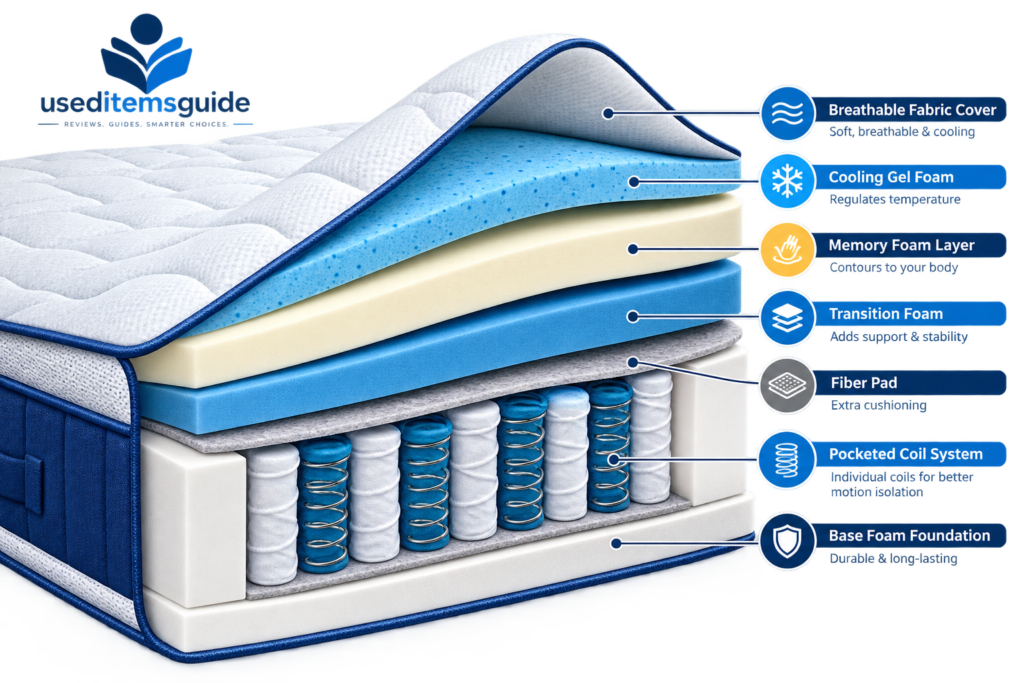
Hybrid mattresses combine a coil support core (like an innerspring) with a foam comfort layer on top, aiming to capture the pressure relief of foam with the responsiveness, airflow, and edge support of coils. This is currently the most popular mattress category among top-rated queen mattresses, including most of our top picks in this guide.
- Pros: better temperature regulation than all-foam, stronger edge support, more responsive/easier to move around on, generally good motion isolation depending on coil design
- Cons: typically heavier and more expensive than all-foam, can still transfer some motion depending on construction quality
- Best for: couples, combination sleepers who change positions frequently, people who run hot but still want some contouring
Innerspring
Traditional innerspring mattresses use a coil support system topped with a comparatively thin comfort layer. This is the oldest mattress construction style and remains widely available, particularly at lower price points and in traditional mattress showrooms.
- Pros: strong airflow and cooling, responsive and bouncy feel, often the most affordable option, widely available for immediate in-store purchase
- Cons: less pressure relief than foam or hybrid, more motion transfer between sleepers, can develop noticeable sagging faster than hybrid or foam models
- Best for: hot sleepers on a tight budget, stomach sleepers who need firmer, more even support
Latex
Latex mattresses use natural or synthetic latex foam, which has a more buoyant, responsive feel than memory foam while still offering good pressure relief. Natural latex (often paired with organic cotton and wool) is also the material behind most “organic” mattress options.
- Pros: naturally cooler than memory foam, durable (natural latex mattresses often last longer than foam), responsive without the slow-sinking memory foam feel, hypoallergenic properties in natural latex
- Cons: generally the most expensive category, heavier and harder to move, less “hug” than memory foam for sleepers who specifically want that contouring feel
- Best for: eco-conscious buyers, people with allergies or chemical sensitivities, hot sleepers who still want some pressure relief
Airbed
Adjustable airbeds use internal air chambers instead of (or alongside) foam or coils, letting you change firmness electronically, often independently on each side of the bed. This is a smaller category but a genuinely useful option for couples with very different firmness preferences.
- Pros: adjustable firmness on demand, ideal for couples with mismatched preferences, some models track sleep data
- Cons: significantly more expensive, more moving parts that can potentially malfunction, heavier and harder to move than other types
- Best for: couples with very different firmness needs, sleepers who want to fine-tune firmness seasonally or as needs change
The Best Queen Mattresses of 2026, Reviewed
Here’s a closer look at each of our top picks, including who each mattress is actually best suited for and where it falls short.
Best Overall: Helix Midnight Luxe
- Type: Hybrid | Firmness: Medium (6/10) | Trial: 100+ nights | Price range: roughly $1,700–$2,000 for queen (frequent sales bring this down significantly)
The Helix Midnight Luxe consistently earns top marks across independent testing panels for its balance of pressure relief, support, and edge support, a combination that’s genuinely hard to find in one mattress. Its medium firmness and pillow-top comfort layer work well across side, back, and combination sleepers, which is exactly why it lands at the top of most best queen mattress roundups rather than just one specific sleep-position category.
- Why it’s a strong pick: broad compatibility across sleep positions, strong edge support (useful for the full width of a queen), good motion isolation for couples
- Where it falls short: on the pricier side before discounts, and dedicated hot sleepers may still want a model with more aggressive cooling technology
Best Budget: Nectar Classic
- Type: Memory foam | Firmness: Medium-firm (6.5/10) | Trial: 365 nights | Price range: roughly $500–$650 for queen
Nectar built its reputation on offering a genuinely long, risk-free trial period at a fraction of the price of premium hybrids, and the Classic remains one of the best values in the memory foam category. It won’t match a premium hybrid’s edge support or cooling performance, but for the price, the pressure relief and motion isolation are hard to beat.
- Why it’s a strong pick: exceptionally long trial period, strong value for the price, good motion isolation typical of all-foam construction
- Where it falls short: sleeps warmer than hybrid options, softer edge support than a coil-based mattress
Best for Couples: Bear Elite Hybrid
- Type: Hybrid
- Firmness: Soft, medium, or firm options
- Trial: 120 nights
- Price range: roughly $1,800–$2,200 for queen
The Bear Elite Hybrid consistently scores at or near the top for the three factors that matter most to couples sharing a queen: motion isolation, edge support, and temperature regulation. Offering three firmness options at purchase is also a real advantage for couples trying to split the difference between different preferences.
- Why it’s a strong pick: multiple firmness options, strong all-around cooling and motion isolation, consistently top-rated specifically for couples in independent testing
- Where it falls short: premium pricing, and picking the wrong firmness option at purchase is a bigger commitment than with an adjustable airbed
Best for Side Sleepers: Amerisleep AS3
- Type: Hybrid (plant-based foam + zoned support)
- Firmness: Medium (5.5–6/10)
- Trial: 100 nights
- Price range: roughly $1,300–$1,600 for queen
The AS3 uses Amerisleep’s Bio-Pur plant-based foam along with HIVE zoned lumbar support, which targets extra support specifically under the lower back while keeping shoulders and hips softer, exactly the pressure distribution side sleepers need. It’s also backed by a notably long 20-year warranty, well above the industry typical 10.
- Why it’s a strong pick: zoned support genuinely tuned for side sleeper pressure points, plant-based foam runs cooler than standard memory foam, exceptional warranty length
- Where it falls short: firmer sleepers may find it too soft, especially for stomach sleeping
Best for Back Pain: Saatva Classic
- Type: Innerspring hybrid (with luxury coil-on-coil construction)
- Firmness: Plush, luxury firm, or firm
- Trial: 365 nights
- Price range: roughly $1,400–$1,700 for queen
Saatva’s Classic uses a dual coil construction with a foam-encased lumbar zone specifically engineered to support the lower back, and it’s a frequent recommendation from physical therapists and spine specialists for exactly that reason. The choice of three firmness levels also makes it easier to match to your specific back pain pattern rather than settling for a single medium option.
- Why it’s a strong pick: dedicated lumbar support zone, three firmness options, white-glove delivery (old mattress removal included) at no extra charge with most orders
- Where it falls short: not available at a physical showroom in most areas, and shipping takes longer than compressed mattress-in-a-box brands
Best Cooling / For Hot Sleepers: Brooklyn Bedding Aurora Luxe
- Type: Hybrid
- Firmness: Soft, medium, or firm
- Trial: 120 nights
- Price range: roughly $1,600–$1,900 for queen
The Aurora Luxe was purpose-built around temperature regulation, using a phase change cooling cover along with gel-infused foam layers designed specifically to pull heat away from the body faster than standard memory foam. It consistently ranks among the top cooling performers in independent testing.
- Why it’s a strong pick: dedicated cooling cover technology, three firmness options, strong pressure relief despite the cooling focus
- Where it falls short: premium pricing puts it in the same tier as other luxury hybrids, and the cooling benefit matters less if you already sleep cold
Best Organic: Avocado Green Mattress
- Type: Latex hybrid
- Firmness: Medium-firm, with a plush pillow-top option available
- Trial: 365 nights
- Price range: roughly $1,500–$1,800 for queen
Avocado uses GOLS-certified organic latex, GOTS-certified organic cotton and wool, and a steel coil support core, making it one of the few genuinely certified-organic mattresses on the market rather than just marketed as “natural.” It’s a strong pick specifically for buyers prioritizing non-toxic materials and sustainability over the softer, more contouring feel of memory foam.
- Why it’s a strong pick: genuine third-party organic certifications (not just marketing language), naturally cooler than foam, exceptionally long trial period
- Where it falls short: firmer and more responsive than a typical hybrid, which some side sleepers may find less contouring than they’d prefer; among the pricier options in this guide
Best Luxury: Stearns & Foster Reserve
- Type: Hybrid with Tempur-Pedic-style foam
- Firmness: Medium, medium-firm, or firm
- Trial: 120 nights
- Price range: roughly $2,600–$3,200 for queen
The Reserve delivers what testers consistently describe as a hotel quality feel, with hand-sewn pillow-top construction and premium foam layers. It’s responsive and pressure relieving enough to suit nearly every sleep position, though the tradeoff for that plush, high-end feel is somewhat weaker motion isolation than other hybrids in this guide, which matters if you’re a light sleeper sharing the bed.
- Why it’s a strong pick: genuine hotel-caliber comfort and construction quality, works well across sleep positions, premium materials throughout
- Where it falls short: by far the most expensive option in this guide, and motion isolation lags behind other hybrids at this price point
Best for Heavy Sleepers (230+ lbs): Titan Plus Luxe
- Type: Hybrid, reinforced support core
- Firmness: Firm (7–7.5/10)
- Trial: 120 nights
- Price range: roughly $1,600–$1,900 for queen
Built specifically for plus-size sleepers, the Titan Plus Luxe uses a reinforced coil system and higher-density foam to prevent the premature sagging that lighter-duty mattresses often develop under higher body weights. In testing, it scores unusually high for comfort across all three major sleep positions specifically among heavier testers, which is a harder balance to strike than it sounds.
- Why it’s a strong pick: purpose-built durability and support for higher body weights, strong scores across all sleep positions for plus-size sleepers specifically, solid edge support
- Where it falls short: firmer profile may feel too rigid for lighter sleepers or dedicated side sleepers under 200 lbs
Best Value Hybrid: Amerisleep AS3 (Revisited)
Worth calling out separately from the “best for side sleepers” category: the AS3’s combination of plant-based foam, zoned lumbar support, a 100-night trial, and an industry-leading 20-year warranty makes it one of the strongest overall value propositions in the mid-range hybrid category, not just for side sleepers specifically.
Understanding the Mattress Firmness Scale
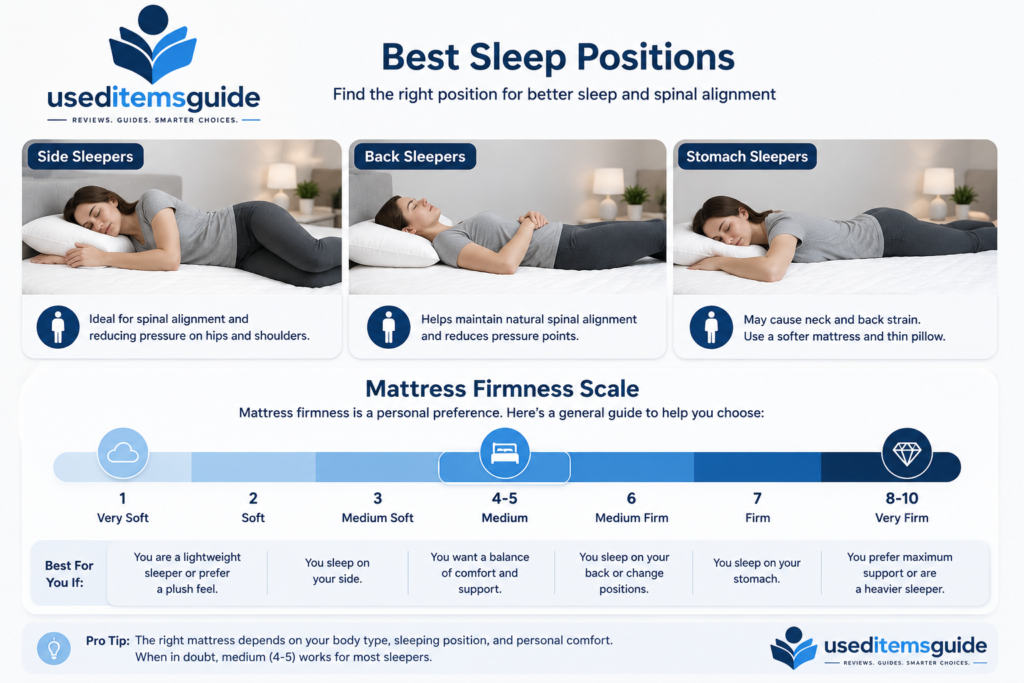
The mattress industry generally uses a 1-to-10 firmness scale, though it’s worth knowing this scale is subjective and not officially standardized, a “6” from one brand can feel different from a “6” from another. Still, it’s a useful starting point for comparison shopping.
| Firmness Rating | Feel | Best For |
| 1–3 (Soft) | Deep contouring, significant sinkage | Lighter side sleepers, people who prioritize a plush feel |
| 4–5 (Medium-Soft) | Noticeable contouring with some support | Side sleepers, lighter-weight combination sleepers |
| 6 (Medium) | Balanced contouring and support | Most sleep positions and body types — the most universally recommended rating |
| 7–8 (Medium-Firm) | Minimal sinkage, strong support | Back and stomach sleepers, heavier sleepers, those with lower back pain |
| 9–10 (Firm) | Very little contouring, maximum support | Stomach sleepers, heavier sleepers, those who specifically dislike a “sinking in” feeling |
If you’re unsure, medium (around a 6) is the safest default, it’s the rating most sleep experts recommend when you don’t have a strong personal preference or specific medical need, since it works reasonably well across sleep positions and body types.
How to Choose a Queen Mattress Based on Sleep Position
Side Sleepers
Side sleeping puts concentrated pressure on the shoulders and hips, so the priority is a mattress with enough contouring to cushion those pressure points while still keeping the spine aligned. Medium to medium-soft firmness (4–6) generally works best, and memory foam or a foam-topped hybrid tends to outperform firmer innerspring options for this position.
- Look for: medium to medium-soft firmness, generous foam comfort layer, good pressure relief at shoulders and hips
- Avoid: very firm mattresses, which can create pressure points and misalign the spine for side sleepers
If side sleeping is your primary concern, we go much deeper on this specific topic in Best Queen Mattress for Side Sleepers (2026).
Back Sleepers
Back sleeping needs support through the lower back (lumbar region) to prevent the hips from sinking out of alignment with the shoulders. Medium to medium-firm (6–7.5) works well for most back sleepers, and a mattress with dedicated lumbar zoning (like the Amerisleep AS3 or Saatva Classic covered above) offers a real, measurable advantage for this position specifically.
- Look for: medium to medium-firm firmness, dedicated lumbar support if available, hybrid or innerspring for airflow
- Avoid: overly soft mattresses that let the hips sink lower than the shoulders and spine
Stomach Sleepers
Stomach sleeping is the position most likely to cause lower back strain if the mattress is too soft, since the hips and midsection sink while the chest stays relatively elevated, curving the spine. Firm to very firm (7–9) is generally the right range, prioritizing even, minimal-sink support over plush contouring.
- Look for: firm to very firm rating, minimal sinkage, innerspring or firmer hybrid construction
- Avoid: soft memory foam mattresses, which allow too much sinkage in the midsection for this position
Combination Sleepers
If you regularly shift between positions through the night, prioritize responsiveness, how easily the mattress lets you move and change positions, over deep contouring. Medium firmness (5.5–6.5) with a hybrid construction generally offers the best balance, since coil support systems are inherently more responsive than dense memory foam.
- Look for: medium firmness, hybrid construction for responsiveness, good edge support if you tend to sleep near the edge
- Avoid: very soft, slow-responding memory foam, which can feel restrictive when changing positions frequently
How to Choose Based on Body Weight
Body weight significantly affects how any given mattress actually feels, since heavier body weight compresses foam and coils more than lighter body weight, the same “medium” mattress can feel noticeably softer under a 250-pound sleeper than under a 130-pound sleeper.
| Body Weight | Recommended Firmness Adjustment | What to Prioritize |
| Under 130 lbs | Softer than the “standard” recommendation for your sleep position | Contouring and pressure relief — lighter bodies don’t compress foam as deeply |
| 130–230 lbs | Standard firmness recommendation for your sleep position applies directly | Balance of support and pressure relief |
| 230+ lbs | Firmer than the “standard” recommendation, or a mattress purpose-built for higher weights (like the Titan Plus Luxe) | Durability and reinforced support cores to prevent premature sagging |
If you’re above 230 lbs, it’s genuinely worth prioritizing mattresses explicitly designed and tested for higher body weights rather than a standard model in a firmer rating, the support cores, coil gauge, and foam density are often meaningfully different in construction, not just firmness.
Mattress Certifications to Look For
Mattress marketing language like “eco-friendly” or “non-toxic” isn’t regulated, so third-party certifications are the only reliable way to verify what’s actually in a mattress. A few certifications come up repeatedly across the mattresses in this guide, and knowing what each one actually means helps you evaluate claims on any mattress you’re considering, not just the ones reviewed here.
- CertiPUR-US — certifies that foam used in a mattress was made without ozone depleters, PBDE flame retardants, mercury, lead, and other heavy metals, and formaldehyde, and meets low VOC emission standards; this is the most common foam certification in the US mattress industry
- GREENGUARD Gold — a broader indoor air quality certification verifying low chemical emissions, often applied to the finished mattress rather than just the foam component
- OEKO-TEX Standard 100 — certifies textiles (mattress covers, fabric) are tested for harmful substances, commonly seen on the outer cover material rather than the foam or coil core
- GOTS (Global Organic Textile Standard) — certifies organic status for textile components like cotton and wool covers, requiring both organic material content and environmentally responsible processing
- GOLS (Global Organic Latex Standard) — the equivalent organic certification specifically for latex, verifying that latex foam is made from certified organic rubber
If certifications matter to your purchase decision, look for them listed explicitly on the product page or verify them directly, CertiPUR-US maintains a public database of certified foams and mattresses you can cross-reference against any brand’s claims.
Trial Periods, Warranties & Return Policies Explained
Because most mattresses today are sold online without the ability to lie on one in a showroom first, the trial period and return policy matter almost as much as the mattress itself. These terms vary more than shoppers expect, and the fine print is worth reading before you buy.
Trial Periods
- Industry standard is 100 to 120 nights, though several brands in this guide (Nectar, Saatva, Avocado) offer a full year
- Most brands require a minimum break-in period, commonly 30 nights, before they’ll accept a return, your body genuinely needs time to adjust to a new mattress, and many complaints in the first couple weeks resolve on their own
- Check whether return shipping and pickup are free, most direct-to-consumer brands cover this, but it’s worth confirming before you buy, especially for heavier hybrid and latex models
- Ask what happens to a returned mattress, reputable brands typically donate returned mattresses to charity or recycle them rather than reselling them as new
Warranties
- 10 years is the industry-standard warranty length; a handful of brands, like Amerisleep, extend this to 20 years
- Warranties typically cover manufacturing defects (broken coils, foam that develops an indentation beyond a specified depth, usually 3/4 to 1 inch) but not normal wear and tear
- Using the wrong foundation or bed frame (one that doesn’t provide adequate, even support) can void a warranty, always check the manufacturer’s frame requirements before setup
- A prorated warranty, common on cheaper mattresses, means you pay an increasing percentage of the replacement cost the older the mattress gets; a non-prorated (full replacement) warranty for the entire term is the better protection and worth prioritizing when comparing similarly priced options
How Much Should You Spend on a Queen Mattress?
Queen mattress prices span an enormous range, from around $300 for a basic foam mattress-in-a-box to $3,000 or more for a luxury hybrid. Rather than anchoring to a single “right” price, it helps to think in tiers based on what you actually need.
| Price Tier | Queen Price Range | What You’re Getting |
| Budget | $300 – $700 | Basic memory foam or lower-density hybrid; fine for guest rooms, growing kids, or short-term use, but often has a shorter realistic lifespan |
| Mid-Range | $700 – $1,500 | The sweet spot for most primary bedrooms — quality hybrid or memory foam construction, solid certifications, industry-standard trial and warranty |
| Premium | $1,500 – $2,500 | Advanced cooling technology, zoned support, multiple firmness options, longer trial periods and warranties |
| Luxury | $2,500+ | Top-tier materials (natural latex, premium foams), hotel-caliber construction, often the longest warranties in the industry |
For most shoppers furnishing a primary bedroom, the mid-range tier delivers the best value, you’re paying for genuine quality and durability improvements over budget options, without the steep price increase for marginal comfort gains that luxury tiers often represent. Reserve the luxury tier for situations where you have a specific need (severe back pain requiring premium zoned support, for example) rather than assuming more expensive automatically means better for your situation.
- Watch for seasonal sales, Presidents Day, Memorial Day, July 4th, Labor Day, and Black Friday/Cyber Monday are the biggest mattress sale events, often bringing premium hybrids down 20-30% from list price
- “List price” on direct-to-consumer mattress sites is often inflated specifically to make ongoing “sale” pricing look more dramatic, compare actual historical pricing (many sites show a price history) rather than assuming a listed discount reflects genuine savings
- Financing options (0% APR promotional plans) are common across most major brands if spreading the cost matters more than the total price
Where to Buy a Queen Mattress
Direct-to-Consumer (Online) Brands
Most of the mattresses in this guide are sold primarily online, shipped compressed in a box, and expand within a few hours of unboxing. This model has become dominant because it cuts out costly showroom overhead, letting brands offer better materials at a given price point than traditional retail.
- Pros: often better value for the materials used, generous trial periods that let you test the mattress at home risk-free, typically free delivery
- Cons: you can’t test the exact mattress in person before buying (though many DTC brands now have limited showroom partnerships), and delivery can take 1-2 weeks for made-to-order models
Traditional Mattress & Furniture Stores
Physical retailers still make sense for some shoppers, particularly if trying before buying matters more than getting the absolute best value.
- Pros: test the actual mattress in person, immediate or fast delivery, in-person help choosing based on your specific needs
- Cons: showroom testing (lying on a mattress for 5 minutes) is a poor substitute for actually sleeping on it over weeks, and markup tends to be higher to cover retail overhead and sales commissions
Delivery & Setup
- Most online orders ship via standard curbside/doorstep delivery, requiring you to carry the box inside and unbox it yourself, manageable for one or two people given a queen mattress typically weighs 120-160 lbs
- “White glove” delivery (offered by Saatva and some other premium brands) includes carrying the mattress to your bedroom, full setup, and often old mattress removal, usually free or a modest add-on fee
- Allow 24-72 hours for a compressed mattress to fully expand and off-gas any initial odor before judging the final feel
- Ask about old mattress removal specifically when ordering if you don’t have a way to dispose of your current mattress, many brands offer this for a fee even without full white-glove service
Should You Ever Buy a Used Queen Mattress?
This is a question most mattress buying guides skip entirely, but it’s worth addressing directly, especially if budget is the primary concern. The short answer: buying a used mattress carries real risks that make it a poor choice in most situations, even though it can seem like an obvious way to save money on one of the most expensive items in a bedroom.
Why Used Mattresses Are Different From Other Secondhand Furniture
Unlike a used dresser or bed frame, a mattress is something you’re in direct, extended contact with every night, which changes the risk calculus considerably. Every new mattress sold in the US is required to meet federal flammability standards under CPSC regulations 16 CFR Parts 1632 and 1633, which govern resistance to both cigarette ignition and open-flame sources. A used mattress, particularly an older one or one without clear documentation, doesn’t come with any way to verify it ever met these standards, or whether any fire-resistant barrier layer has degraded over years of use.
- Bed bugs — used mattresses are one of the most common ways bed bug infestations spread between households, and bed bugs can survive for months hidden deep in the seams and internal layers of a mattress, invisible during a quick visual inspection
- Hygiene and allergens — dust mites, sweat, skin cells, and other biological material accumulate inside a mattress over years of use in ways that can’t be fully cleaned from the outside, regardless of how good a secondhand mattress looks
- Hidden structural wear — sagging, broken coils, or compressed foam aren’t always obvious from sitting on a mattress in a seller’s home for a few minutes, and these issues often don’t become apparent until you’ve slept on it for weeks
- No warranty or trial period — mattress warranties are generally non-transferable to a second owner, meaning a used mattress purchase comes with zero protection if it turns out to be worn out or defective
When a Used Mattress Might Be a Reasonable Exception
There are a few narrow situations where secondhand makes more sense than these general risks suggest:
- The mattress is barely used and coming from someone you know and trust, who can confirm its age, history, and that it’s never had a bed bug issue, a mattress from a family member’s guest room, for example, carries far less uncertainty than one from an anonymous online listing
- It’s a genuinely short-term need (a few months in temporary housing) where the mattress will be discarded afterward anyway
- You’re comfortable thoroughly inspecting and, ideally, having the mattress professionally cleaned before use
Even in these cases, a queen mattress is a big enough investment in your daily health and sleep quality that the budget tier of new mattresses covered earlier in this guide (starting around $300-$500) is worth strongly considering as an alternative before buying used.
If You Do Consider a Used Mattress: What to Check
- Inspect every seam and fold carefully for small reddish-brown stains, dark spotting, or shed insect skins, signs of bed bugs that are easy to miss in a quick glance
- Ask directly about the mattress’s age, most mattresses have a realistic usable lifespan of 7-10 years, and anything older has likely lost significant support regardless of how it looks
- Press firmly across the entire surface checking for soft spots, sagging, or uneven support, not just the center
- Smell the mattress closely for mildew or mold odor, particularly if it’s ever been stored in a basement or garage
- Never buy a mattress that’s been discarded curbside or left outdoors, even briefly, moisture and pest exposure risk increases dramatically
Selling or Donating Your Old Mattress
If you’re upgrading and need to get rid of your current mattress, a few practical options exist beyond leaving it at the curb:
- Many new-mattress retailers, especially those offering white-glove delivery, will haul away your old mattress for a modest fee ($50-$150 is typical) at the time of your new mattress delivery
- Mattress recycling programs exist in many states and cities specifically because mattresses are bulky and difficult for standard waste haulers to process, search your city’s waste management site for local mattress recycling options
- Donation is only appropriate for a mattress in genuinely good condition, well within its usable lifespan, and free of any signs of pests or damage, most charitable organizations will decline mattresses that don’t meet these standards
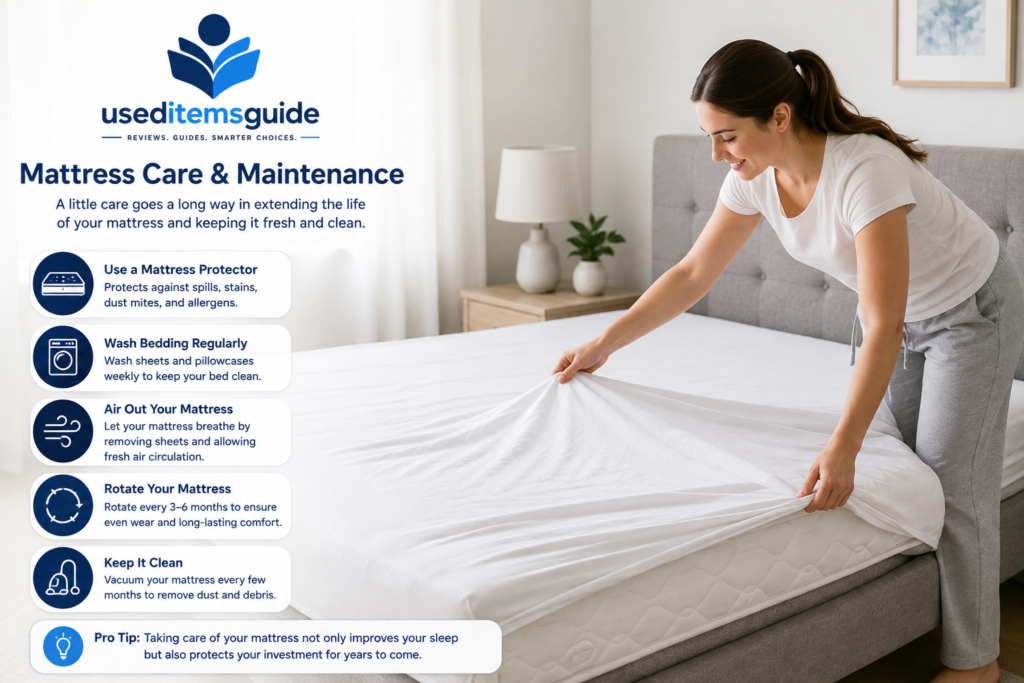
Mattress Care & Maintenance: Getting the Most Life Out of Your Queen Mattress
A quality queen mattress represents a meaningful investment, and basic care can meaningfully extend its usable lifespan and help you get the full comfort and support it’s designed to provide.
- Use a mattress protector from day one, this is the single most impactful habit for protecting your investment, guarding against spills, sweat, and allergens while most brands’ warranties actually require one to remain valid
- Rotate (not flip) most modern mattresses every 3-6 months, foam and hybrid mattresses are typically designed to be slept on one side only, so rotating head-to-foot helps even out wear without flipping the mattress upside down
- Ensure your foundation or frame provides even, adequate support across the full surface, slats spaced more than 3 inches apart, or a sagging foundation, will cause premature indentations regardless of mattress quality
- Let a new mattress air out for 24-48 hours after unboxing before judging the final smell and feel, some initial off-gassing odor is normal and typically resolves within the first few days
- Vacuum the mattress surface periodically (with the protector removed) to reduce dust mite and allergen buildup over time
- Avoid jumping or standing on the mattress, which accelerates wear on both foam and coil components well beyond normal use
- Keep pets off the mattress when possible, or use a dedicated pet blanket, this reduces both wear and allergen buildup significantly
How Long Should a Queen Mattress Last?
Most quality mattresses are designed for a 7-10 year usable lifespan, though this varies by construction type. Latex tends to hold up longest (often 10-15 years with proper care), followed by hybrids (7-10 years), with all-foam and traditional innerspring mattresses on the shorter end of that range. Signs it’s time to replace a mattress regardless of its exact age include visible sagging or indentations deeper than an inch, waking up with new aches or pain that weren’t there before, noticeably reduced motion isolation or support compared to when it was new, and persistent allergy symptoms that improve when sleeping elsewhere.
Common Mistakes When Buying a Queen Mattress
A few avoidable mistakes account for most of the regret shoppers report after a mattress purchase, whether online or in-store:
- Judging firmness from a 5-minute showroom lie-down — a mattress that feels perfect for a few minutes in street clothes can feel completely different after a full night’s sleep; this is exactly why trial periods exist, and why leaning on a long trial period matters more than in-store testing alone
- Choosing based on what a partner prefers without accounting for your own sleep position and body weight — if your needs genuinely conflict, prioritize a mattress with multiple firmness options or consider an adjustable airbed rather than compromising on a single medium option that suits neither of you well
- Ignoring the foundation or frame — even the best mattress will underperform and may void its warranty on an inadequate or sagging foundation; budget for a proper foundation as part of your total mattress cost, not as an afterthought
- Assuming a higher price always means better quality — some of the best value mattresses in this guide (Nectar Classic, for example) significantly outperform pricier competitors for specific needs; match the mattress to your actual requirements rather than defaulting to the most expensive option
- Not accounting for delivery timeline — made-to-order premium mattresses can take 1-2 weeks to arrive; if you need a mattress immediately, factor this into your shopping timeline or consider a stocked traditional retailer instead
- Skipping the trial period break-in requirement — returning a mattress after only a few nights, before your body has had time to adjust, is one of the most common reasons people return a mattress that likely would have worked out given more time
- Forgetting to measure the room and doorways before ordering — a queen mattress and frame need to physically fit through hallways, stairwells, and doorways during delivery, which can be a genuine problem in older homes with narrower doorways
More Queen Mattresses Worth Considering
The picks above cover the strongest option in each major category, but a few other well-regarded brands are worth a mention if the above don’t quite fit your specific situation.
Purple Restore
Built around Purple’s proprietary hyper-elastic polymer grid instead of traditional foam, the Restore offers a genuinely different feel, highly responsive and breathable in a way foam struggles to match, with good pressure relief that doesn’t come with the “stuck in the bed” sensation some sleepers dislike about memory foam. Worth considering specifically if you’ve tried memory foam before and found it too contouring.
Casper Original
One of the original direct-to-consumer mattress brands, the Casper Original uses zoned foam support (softer under the shoulders, firmer under the hips and lower back) at a mid-range price point. A solid all-around choice for combination sleepers who change positions frequently through the night.
Tuft & Needle Original
A straightforward, no-frills all-foam mattress that consistently ranks as one of the better budget options, with proprietary cooling foam that performs better on temperature than most mattresses in its price bracket.
DreamCloud Premier
A hybrid offering a luxury feel (cashmere-blend cover, quilted pillow top) at a more accessible price point than most premium hybrids in this guide, making it a reasonable middle ground between the budget and premium tiers.
Layla Hybrid
Notable for being flippable, one side firm, one side soft, giving genuine firmness flexibility without needing to order a specific firmness level upfront. A good option if you’re genuinely unsure which firmness you’ll prefer.
WinkBed
A plush, airy pillow-top hybrid frequently recommended for back and side sleepers, with a notably breathable construction for a mattress with this much cushioning. Motion isolation is a relative weak point, worth factoring in if you’re a light sleeper sharing the bed.
Adjustable Bases & Platform Beds: What Works With a Queen Mattress
Not every queen mattress is compatible with every type of base, and using the wrong one can affect both comfort and your warranty.
- Platform beds (solid or slatted base with no box spring) work well with most modern hybrid, foam, and latex mattresses, as long as slats are spaced no more than about 3 inches apart
- Box springs are mostly a legacy requirement from older innerspring mattress designs, check your specific mattress brand’s requirements, since many modern hybrids and all-foam mattresses don’t need one and some warranties are voided by using one incorrectly
- Adjustable bases (which raise the head and/or foot electronically) require a mattress specifically rated as adjustable-base compatible, most modern foam, hybrid, and latex mattresses qualify, but always confirm with the specific brand before buying, since flexing at an angle can damage a mattress not designed for it
- Queen-size adjustable bases are widely available and typically cost $500-$1,500 depending on features (massage functions, USB charging, under-bed lighting)
Buying a Queen Mattress for a Kid’s Room or Guest Room
The buying priorities shift somewhat for secondary bedrooms compared to a primary bedroom mattress:
- For a guest room, a mid-firm, broadly comfortable option (rather than one tuned to a specific sleep position) serves the widest range of occasional guests well
- For an older child or teen’s first queen bed (upgrading from a twin), a budget-to-mid-range mattress is usually sufficient, since growing kids’ preferences and needs will likely change again within several years
- Guest rooms and kids’ rooms are reasonable places to prioritize value over premium features like advanced cooling technology or zoned lumbar support, which matter more for a mattress used every single night
Frequently Asked Questions About Queen Mattresses
What are the exact dimensions of a queen mattress?
A standard US queen mattress measures 60 inches wide by 80 inches long. This dimension is standardized across the entire mattress industry, so any queen mattress will fit any queen bed frame or foundation, regardless of brand.
What’s the difference between a queen size mattress and a full size mattress?
A queen mattress is 6 inches wider and 5 inches longer than a full mattress (60×80 versus 54×75 inches). That difference is significant enough that two adults sharing a full mattress will have noticeably less personal space than on a queen, closer to what a single sleeper experiences on a twin.
How much does a good queen mattress cost?
A good queen mattress typically ranges from $700 to $1,600, covering the mid-range to premium tiers where most shoppers find the best combination of quality, durability, and value. Budget options start around $300-$500, while luxury mattresses can exceed $2,500.
What is the best queen bed mattress for back pain?
The Saatva Classic is a frequent recommendation from physical therapists and spine specialists for back pain, thanks to its dedicated lumbar support zone and choice of three firmness levels. Medium-firm mattresses generally work best for back pain across most body types, since they support the spine’s natural alignment without creating pressure points.
How firm should a queen mattress be?
Most sleepers do well with a medium to medium-firm mattress (5.5 to 7 on the standard 10-point firmness scale), which balances pressure relief with adequate support. Side sleepers generally prefer softer options (4-6), back sleepers do well in the medium range (5-7), and stomach sleepers typically need firmer support (6-8) to prevent the hips from sinking too deeply.
How long does a queen mattress take to ship and set up?
Most direct-to-consumer mattresses ship within 3-7 business days, arriving compressed in a box. Some made-to-order premium models can take 1-2 weeks. Once unboxed, a mattress needs roughly 24-72 hours to fully expand and off-gas before you should judge its final feel.
Do I need a box spring with a queen mattress?
Most modern hybrid, foam, and latex mattresses don’t require a box spring and work fine on a slatted platform bed or solid foundation, as long as slats are spaced no more than about 3 inches apart. Box springs are largely a legacy requirement tied to older traditional innerspring mattress designs, always check your specific mattress brand’s foundation requirements, since using the wrong setup can void your warranty.
What’s the best queen mattress for couples?
The Bear Elite Hybrid consistently scores at or near the top for the three factors that matter most to couples: motion isolation, edge support, and temperature regulation. It also offers multiple firmness options, which helps when partners have different preferences.
How often should I replace my queen mattress?
Most quality mattresses have a usable lifespan of 7-10 years, though latex mattresses can last 10-15 years with proper care. Replace sooner if you notice visible sagging deeper than an inch, new aches upon waking, or reduced support compared to when the mattress was new.
Can two people comfortably sleep on a queen mattress?
Yes — queen is the most popular size specifically for couples, offering roughly 30 inches of personal space per person. It’s a smaller footprint than a king (which offers about 38 inches per person), but comfortably accommodates most couples in a standard-size primary bedroom.
What mattress type is best for hot sleepers?
Hybrid and latex mattresses generally sleep cooler than all-foam options, thanks to better airflow through coils or the naturally breathable structure of latex. If you’re specifically prioritizing cooling, look for a model with a dedicated cooling cover or gel-infused foam, like the Brooklyn Bedding Aurora Luxe.
Is it worth buying a mattress in-store versus online?
Buying online from a direct-to-consumer brand generally offers better value for the materials used, thanks to lower overhead than physical retail. In-store buying lets you test the exact mattress before committing and often means faster delivery, but tends to come with higher markup. A long trial period (100+ nights) largely offsets the inability to test an online mattress in person beforehand.
What should I look for in a queen mattress warranty?
Look for at least a 10-year warranty (the industry standard), ideally non-prorated for the full term rather than one where your coverage decreases over time. Confirm what specifically voids the warranty, since using an incompatible foundation is one of the most common ways buyers accidentally lose coverage.
Are more expensive queen mattresses always better?
Not necessarily. Price often reflects premium materials, advanced cooling technology, or luxury branding, but the right mattress depends on matching construction and firmness to your specific sleep position, body weight, and any particular needs like back pain or temperature regulation, not simply choosing the highest price point available.
Can I use a queen mattress on a full-size bed frame?
No — a queen mattress (60×80 inches) will not fit properly on a full-size frame (54×75 inches), since it’s both wider and longer. You’ll need a queen-specific frame or foundation sized to match.
Mattress Accessories You’ll Need
A new queen mattress is only part of a complete setup. A few accessories are worth budgeting for alongside the mattress itself, rather than as an afterthought once it arrives.
- Mattress protector — as covered above, this is close to essential both for hygiene and for keeping most warranties valid; budget $30-$80 for a quality queen-size protector
- Queen sheets — make sure to check your mattress height before ordering; taller hybrid and pillow-top mattresses (often 12-14+ inches) need “deep pocket” sheets, while standard sheets may not stay fitted on a tall mattress
- Foundation or bed frame — if you don’t already have a compatible one, budget $150-$400 for a quality queen platform frame or foundation, factoring this into your total mattress budget from the start
- Mattress topper — worth considering if your mattress arrives firmer or softer than expected after the trial period begins; a topper can meaningfully adjust feel without requiring a full return, for roughly $50-$200 depending on material
- Pillows — often overlooked, but pillow height and firmness should match your new mattress’s feel and your sleep position for the full comfort benefit to come through
Complete Queen Mattress Shopping Checklist
Use this as a final run-through before you commit to a purchase:
- Identify your primary sleep position (side, back, stomach, or combination) and match it to the firmness guidance covered earlier in this guide
- Factor in body weight, lighter sleepers generally want softer options, heavier sleepers need firmer, more reinforced support
- Decide on a mattress type (hybrid, memory foam, innerspring, latex, or airbed) based on the tradeoffs covered above, particularly around cooling and motion isolation
- Set a budget tier and stick to it, remember that mid-range ($700-$1,500) delivers the best value for most primary bedrooms
- Confirm the trial period length and return policy details, including who pays return shipping
- Check the warranty length and whether it’s prorated or full-coverage for the entire term
- Verify your foundation or frame is compatible, and budget for a new one if needed
- Measure your room, doorways, and stairwells to confirm the mattress and frame can physically be delivered and set up
- Look for relevant certifications (CertiPUR-US, GREENGUARD, OEKO-TEX, or organic certifications) if materials safety and sustainability matter to your decision
- Time your purchase around a major sale event if you’re not in a rush, since seasonal discounts on premium hybrids can be substantial
- Arrange for old mattress removal or donation ahead of your new mattress’s delivery date
Understanding the Technical Specs: What the Numbers Actually Mean
Mattress product pages are full of numbers, foam density, coil count, gauge that can be genuinely useful for comparing options, if you know what they indicate. Here’s a plain-language breakdown.
Memory Foam Density
Measured in pounds per cubic foot (PCF), foam density is one of the better indicators of a foam mattress’s durability, independent of firmness (which is a separate spec).
- Low density (below 3 PCF) — least durable, more prone to developing body impressions over a few years; common in budget mattresses
- Medium density (3-5 PCF) — the sweet spot for most quality mattresses, balancing durability with responsiveness and cost
- High density (5+ PCF) — most durable and best at isolating motion, but can trap more heat and feel slower to respond to movement
Density and firmness are independent specs, a mattress can be high-density and still feel soft, or low-density and feel firm. If a product page only lists firmness without density, that’s worth asking about directly, since density tells you more about how long the mattress will actually hold up.
Coil Count and Gauge (Hybrid & Innerspring Mattresses)
- Coil count for a queen mattress typically ranges from around 800 to 1,500, generally, more coils mean more precise, contouring support, though this matters less once you’re above roughly 1,000 for a queen
- Gauge refers to wire thickness, Lower gauge numbers mean thicker, firmer wire (13-14 gauge is firmer/more durable), while higher gauge numbers (15-18) mean thinner, more flexible, and typically less durable wire
- Pocketed coils (individually wrapped in fabric) isolate motion far better than older interconnected coil systems, and are standard in nearly all quality modern hybrids
- Zoned coil systems, using different gauge coils in different areas of the mattress (firmer under the hips, softer under the shoulders), are common in premium hybrids and generally worth prioritizing over a uniform coil system
How to Read Mattress Reviews Critically
Online mattress reviews are notoriously unreliable in places, given how much affiliate revenue is tied to mattress recommendations across the internet. A few habits help you separate genuinely useful reviews from marketing dressed up as editorial content.
- Look for reviews that mention specific testing methodology (in-house lab testing, named testers, disclosed panel sizes) rather than vague claims of “we tested this mattress”
- Be skeptical of any single “best” list that conveniently ranks the reviewer’s highest-commission affiliate partner as the top overall pick across every category
- Cross-reference recommendations across at least two or three independent sources rather than trusting a single roundup, since methodology and potential bias vary meaningfully between publishers
- Verified purchase reviews on retailer sites, while imperfect, offer a real-world data point that professional review sites sometimes miss, particularly around long-term durability that a short testing window can’t capture
- Weight reviews from sleepers with a similar body type and sleep position to your own more heavily than the aggregate star rating, since mattress comfort is genuinely personal and what works well for one sleep profile can perform very differently for another
Is a thicker mattress always better?
Not necessarily. Thickness (often 10-14+ inches for hybrids) relates more to the number and type of comfort layers than to quality or durability on its own. A well-constructed 10-inch mattress can outperform a poorly built 14-inch one, thickness is worth considering for aesthetic proportion with your bed frame and ease of getting in and out of bed, but it’s not a reliable standalone quality signal.
Can I negotiate the price of a queen mattress?
At traditional mattress and furniture stores, yes, sales staff often have some flexibility, especially near the end of a month or during a promotional event. Direct-to-consumer online brands generally have fixed pricing, though timing your purchase around a major sale event achieves a similar effect.
What’s the return process like if a mattress doesn’t work out?
Most direct-to-consumer brands handle this by scheduling a pickup (often through a local charity partner) and processing a full refund once the pickup is confirmed, typically within a week or two of your return request. Always initiate a return through the brand’s official process rather than trying to resell a disliked mattress yourself, since attempting resale forfeits any refund and passes along a mattress with no verifiable condition history to the next buyer.
Do queen mattresses come with a foundation included?
Rarely, most mattresses, especially direct-to-consumer models, are sold as the mattress only, with the foundation or frame as a separate purchase. Some brands offer mattress-and-foundation bundles at a discount compared to buying separately, which is worth checking if you need both.
Why do some queen mattresses have a strong smell when first unboxed?
This is called off-gassing, caused by the compression and vacuum-sealed packaging process, and it’s normal for foam and hybrid mattresses. It typically fades significantly within 24-72 hours in a well-ventilated room. A persistent strong odor beyond a week or so is worth contacting the manufacturer about, though this is uncommon with CertiPUR-US certified foam.
The Bottom Line
A queen mattress remains the best default choice for most bedrooms and most couples, balancing comfort, cost, and practicality better than any other size. The right specific mattress for you depends less on chasing the single “best” model and more on matching construction type and firmness to your actual sleep position, body weight, and budget, the Helix Midnight Luxe earns its reputation as a strong all-around pick precisely because it performs well across a wide range of those factors, but the best mattress for a dedicated side sleeper with back pain concerns and a tight budget looks different than the best mattress for a hot-sleeping couple with room to spend on a luxury hybrid.
Take the time to actually think through sleep position, firmness preference, and budget tier before you shop, lean on a long trial period rather than a five-minute showroom test, and don’t skip the accessories (protector, proper foundation, right sheets) that make the difference between a mattress performing as designed and underperforming on a mismatched setup.
“Mattress in a Box” vs. Traditional Mattresses: Is There Really a Difference?
The compressed, rolled, boxed shipping format that defines most direct-to-consumer brands sometimes gets treated as a separate category from “real” mattresses, but that’s a misunderstanding of the manufacturing process. Compression for shipping is a packaging and logistics choice, not a construction difference — the same hybrid or foam mattress could be delivered flat on a truck (as traditional retail does) or compressed and rolled into a box, without any change to the materials or quality inside.
- What actually varies between brands is materials, density, coil quality, and construction, not whether the mattress arrived compressed
- Compression and vacuum-sealing does not damage foam or coils in a well-made mattress; the format has been standard across the industry for over a decade at this point, including from long-established traditional brands, not just newer online-only companies
- The genuine tradeoff is delivery experience, not mattress quality, a boxed mattress requires you to carry it inside and unbox it yourself unless you pay for white-glove service, while traditional retail delivery brings a flat mattress directly to your room
Red Flags to Watch for When Shopping
A few warning signs are worth taking seriously regardless of which brand or retailer you’re considering:
- No clearly stated trial period or return policy — reputable brands make this information easy to find, not buried or vague
- Certifications claimed but not verifiable — if a brand claims CertiPUR-US or GOTS certification, you should be able to confirm it against that certification body’s public database
- Prices that seem dramatically below every competitor for supposedly identical materials and construction — this can indicate lower-quality components than advertised, counterfeit certification claims, or in rare cases a scam storefront with no real product behind it
- Pressure to buy immediately due to a “today only” sale that reappears every time you visit the site — a common (if relatively harmless) sales tactic worth recognizing rather than a genuine reason to skip your research
- No physical business address or customer service contact beyond a contact form — a legitimate mattress company, even an online-only one, should have verifiable contact information and a real return address for shipping returns
Financing and Timing Your Purchase
Beyond seasonal sales, a few other timing and payment factors can affect your total cost:
- Most major brands offer 0% APR financing through third-party providers (Affirm, Klarna, or similar) for qualified buyers, letting you spread a $1,000+ purchase over several months without added interest
- End-of-quarter and end-of-month timing can occasionally yield better deals at traditional retail stores, where sales staff may have quotas to hit
- Bundle discounts (mattress plus foundation, or mattress plus sheets and a protector) are common and often save more than buying each piece separately at full price
- If you’re not in a rush, waiting for one of the major sale events (Presidents Day, Memorial Day, July 4th, Labor Day, Black Friday/Cyber Monday) can mean a meaningfully lower price on the exact same mattress
Choosing a Queen Mattress for Specific Health Conditions
Beyond general sleep position and body weight guidance, a few common health conditions call for more specific mattress considerations. Sleep quality itself has real, well-documented health consequences, the National Heart, Lung, and Blood Institute (NHLBI), part of the NIH, notes that roughly 50 to 70 million Americans have a sleep disorder and that a third of adults don’t regularly get adequate uninterrupted sleep, so getting the mattress fundamentals right is worth taking seriously, not treating as a minor comfort preference. None of what follows is a substitute for guidance from your own doctor or physical therapist, but it’s a reasonable starting point for narrowing your search.
Lower Back Pain and Sciatica
Medium-firm mattresses with dedicated lumbar zoning (like the Saatva Classic or Amerisleep AS3) tend to perform best, since they support the natural curve of the spine without letting the hips sink too deeply, a common trigger for sciatic nerve irritation. Both too-soft and too-firm mattresses can worsen lower back symptoms, too soft allows the spine to bow out of alignment, while too firm creates pressure points at the hips and shoulders that can indirectly strain the lower back.
Fibromyalgia and Chronic Pressure Sensitivity
Softer, more contouring options (typically all-foam or foam-forward hybrids in the 4-5.5 firmness range) generally work better for pressure-sensitive conditions, since they distribute weight across a larger surface area rather than concentrating it at specific pressure points. Memory foam’s slow-recovery contouring is often specifically well-suited here, more so than the quicker-responding feel of latex or innerspring.
Arthritis
A medium mattress that makes getting in and out of bed easier (not so soft that you sink in and struggle to reposition) tends to work best. Taller mattresses combined with an appropriately-sized bed frame can also make transitions in and out of bed physically easier for those with joint stiffness or mobility limitations.
Sleep Apnea and Positional Considerations
While a mattress alone doesn’t treat sleep apnea, an adjustable base that elevates the head can help some sleepers, and it’s worth confirming your chosen mattress is adjustable-base compatible if this is a relevant consideration for you or a partner.
For any chronic pain condition, remember that a mattress’s actual effect on symptoms is genuinely individual, and a long trial period is especially valuable here, what helps one person’s back pain can worsen another’s, even with the exact same diagnosis. Use the trial period fully rather than assuming a highly-rated mattress for a given condition will automatically work for you specifically.
Why Queen Is the Most Popular Mattress Size
It’s worth stepping back to explain why queen consistently outsells every other mattress size in the US. The core reason is that it hits a genuine sweet spot: enough width and length for two average-height adults to sleep without feeling cramped, while still fitting comfortably in the vast majority of primary bedrooms built in the US over the past several decades. King mattresses require a meaningfully larger room to avoid feeling like the bed dominates the space, and full or twin mattresses simply don’t offer enough room for two adults long-term. That combination of practicality and comfort is why queen has held the top sales position across the mattress industry for years, and why the sheer volume of search interest in “queen mattress,” “queen size mattress,” and related terms consistently outpaces every other size.
Unboxing and Setting Up Your New Queen Mattress
If you’ve never dealt with a compressed mattress-in-a-box before, the process is straightforward but a few tips make it go more smoothly.
- Set up your frame or foundation first, completely, before bringing the mattress box into the room, it’s much easier to maneuver an empty box than a fully expanded mattress
- Cut the plastic wrapping carefully from the end, not the middle, following any marked cut lines, cutting in the wrong spot risks damaging the mattress cover underneath
- Unroll the mattress directly onto its frame or foundation rather than the floor, since dragging a heavy, partially-expanded mattress afterward is considerably harder
- Expect most of the expansion to happen within the first 10-30 minutes, but give it the full 24-72 hours recommended by the manufacturer before final judgment on feel and firmness
- Recycle the packaging responsibly, the outer plastic wrap is often recyclable through store drop-off programs (similar to plastic shopping bags) rather than curbside recycling, since most curbside programs don’t accept film plastic
- If setting up alone, a queen mattress (120-160 lbs) is manageable for most people, but the box itself can be awkward to carry up stairs or through narrow hallways, a second person makes this meaningfully easier
What’s the best queen mattress for a platform bed?
Nearly any modern hybrid, foam, or latex mattress works well on a platform bed, as long as the slats are spaced no more than about 3 inches apart. The Helix Midnight Luxe and Amerisleep AS3, both covered above, are popular choices specifically because they don’t require a box spring.
How do I know what firmness number I actually need?
Start with your primary sleep position as the biggest factor: side sleepers generally want 4-6 on the 10-point scale, back sleepers 5-7, and stomach sleepers 6-8. Then adjust based on body weight, heavier sleepers typically need to size up in firmness by about one point from these ranges, while lighter sleepers can size down slightly, since body weight changes how deeply you sink into any given firmness level.
Is it normal for a new mattress to feel different than expected at first?
Yes, to some degree, most manufacturers recommend a 30-night minimum adjustment period before judging a mattress, since your body and sleep habits are adapting to a new surface at the same time the mattress itself is fully settling. A mattress that feels notably too firm or too soft after the full adjustment period, not just the first few nights, is a legitimate reason to consider a return within your trial window.
Eco-Friendly and Sustainable Queen Mattress Options
If environmental impact factors into your decision alongside comfort and price, a few things are worth knowing beyond the certifications covered earlier in this guide.
- Natural latex (as used in the Avocado Green Mattress) is a renewable material, tapped from rubber trees without cutting them down, unlike petroleum-based memory foam
- Organic cotton and wool covers, verified by GOTS certification, are grown and processed without the synthetic pesticides and chemical treatments used in conventional textile production
- Look for take-back or recycling programs, some brands, including several covered in this guide, will accept your old mattress for recycling rather than landfill disposal when your new one is delivered
- A longer-lasting mattress is itself a sustainability choice, a latex or high-density hybrid that lasts 12-15 years has a meaningfully smaller lifetime environmental footprint than replacing a cheaper mattress every 5-6 years, even accounting for the higher upfront materials cost
- Packaging matters too, inquire whether a brand uses recyclable or minimal packaging materials if this is a priority, since mattress shipping materials vary considerably between companies
A Final Note on Personal Preference
Every recommendation in this guide is grounded in testing data, published specifications, and well-established industry patterns, but mattress comfort remains genuinely subjective in ways that no guide can fully account for. Two people with identical sleep positions, body weights, and stated preferences can end up preferring completely different mattresses once they’ve actually slept on them for a few weeks. That’s exactly why this guide leans so heavily on trial periods, return policies, and understanding your own specific needs rather than simply pointing at a single “best” mattress and calling the decision made. Use the category picks above as a genuinely well-researched starting point, lean on the firmness and sleep-position guidance to narrow your options, and then trust a real trial period to confirm the final choice rather than a showroom test or a five-star review from someone whose body and sleep habits may be nothing like your own.
Putting It All Together: How to Actually Decide
If you’ve read this far and still aren’t sure where to start, here’s a simple decision path that works for most shoppers:
- Step 1 — Confirm queen is the right size for your room using the dimensions and room-size guidance earlier in this guide
- Step 2 — Identify your primary sleep position (side, back, stomach, or combination) and use that to narrow your firmness range
- Step 3 — Factor in body weight, since it shifts the ideal firmness within that range, sometimes significantly for sleepers above roughly 230 lbs
- Step 4 — Set a realistic budget using the price-tier guidance above — the $800–$1,600 mid-range tier is where most shoppers find the best balance of quality and cost
- Step 5 — Shortlist two or three mattresses from the picks in this guide that match your sleep position, weight, and budget
- Step 6 — Buy from a brand offering at least a 100-night trial period, and actually use the full trial window before deciding whether to keep it
This process won’t guarantee a perfect match on the first try, no guide can promise that, given how individual sleep comfort really is, but it will consistently get you a well-matched, well-reasoned choice rather than a guess based on a showroom test or a single online review.
Related guides in this series:
Best Queen Mattress for Side Sleepers (2026)
Queen Mattress Dimensions: Complete Size & Room Guide
Queen vs. King Mattress: Which Is Right for You?
Browse all guides on useditemsguide.com
Sources
U.S. Consumer Product Safety Commission — Mattress Flammability Standards (16 CFR 1632/1633)
CertiPUR-US — Certified Foam Standards & Database
National Heart, Lung, and Blood Institute (NIH) — Sleep Health
