
That $50 gift card from a store you never visit isn’t doing you any good sitting in a drawer. The good news: you can turn unwanted gift cards into real money. Online exchanges, peer-to-peer marketplaces, local buyers and even friends will pay you for them, and some will pay close to face value.
This guide explains exactly where to sell gift cards for cash in 2026, how much each option typically pays, how to avoid the scams that target gift card sellers, and simple tricks to get the highest payout. If you’re on the other side of the deal and want to buy gift cards instead, see our guide on where to buy Amazon gift cards.
Key Takeaways
- Online exchanges like CardCash typically pay about 70%–90% of a card’s balance, with payment in a few business days.
- Peer-to-peer sites like Gift Card Exchange (formerly Raise) let you set your price, but you wait for a buyer and pay seller fees.
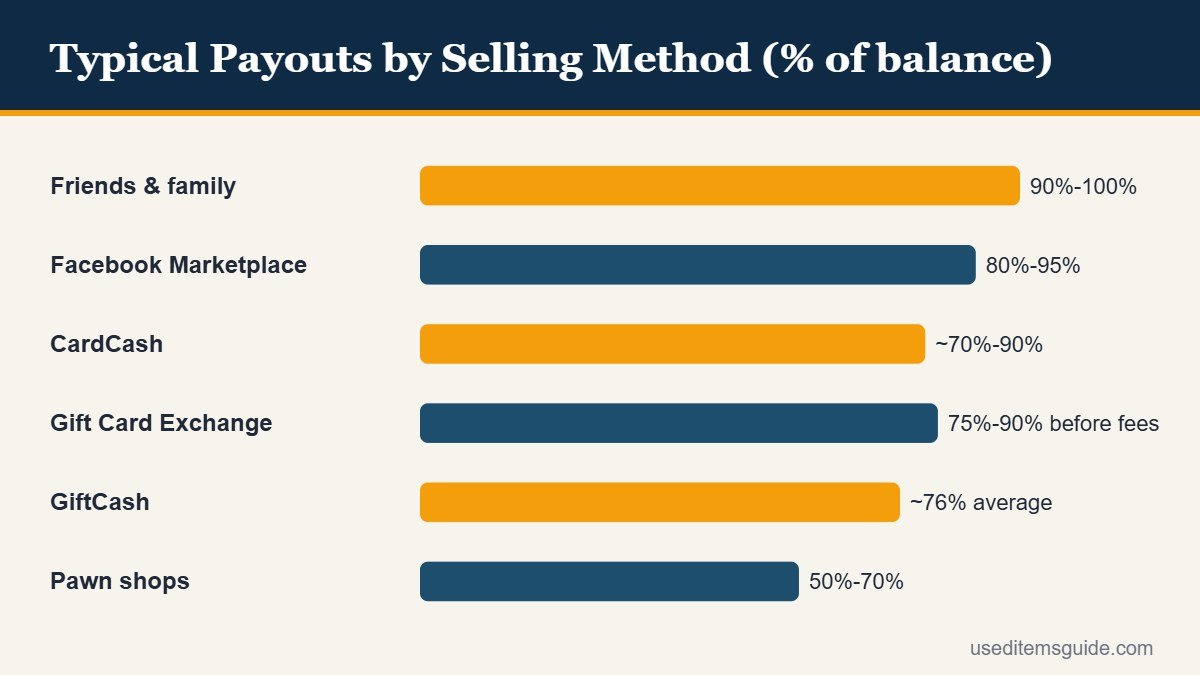
- Selling to friends or family can get you 90%–100%, while pawn shops often pay only 50%–70%.
- Popular store brands (Target, Walmart, Amazon, Home Depot) sell for the most; prepaid Visa and Mastercard cards are harder to sell.
- Never share a card number or PIN before you’re paid, and never sell to someone who asks you to send money back.
Table of Contents
- How Selling Gift Cards Works
- Best Places to Sell Gift Cards Online
- Places to Sell Gift Cards Locally
- Comparison Table: Payouts & Speed
- How Much Can You Get for a Gift Card?
- How to Sell a Gift Card Step by Step
- How to Avoid Gift Card Scams
- Alternatives to Selling
- Gift Card Rules That Can Save You Money
- FAQs
How Selling Gift Cards Works
When you sell a gift card, you trade its remaining balance for a smaller amount of cash. The buyer takes a discount because they’re taking on risk and need to resell the card at a profit. There are three main ways to do it:
- Instant-offer exchanges: You enter the brand and balance, get a quote, and the company buys the card directly. Fast and simple, but you accept their price.
- Peer-to-peer marketplaces: You list the card at a price you choose and wait for a buyer. You can earn more, but it takes longer and fees apply.
- Local or personal sales: You sell to someone you meet or know. Payouts can be high, but scams are more common with strangers.
Which option is best depends on two things: how quickly you need the money and how popular the brand is. A Target or Amazon card is easy to sell almost anywhere; a card for a small regional restaurant chain may only get a low offer, or none at all.

Best Places to Sell Gift Cards Online
Online gift card exchanges come and go. Several well-known names have stopped buying cards in recent years, so always check that a site is still active and read recent reviews before you send a card. Here are the main options available today.
1. CardCash
CardCash is one of the longest-running gift card exchanges in the US. You enter the brand and balance and receive an instant offer. According to The Penny Hoarder, it typically pays around 70% to 90% of the balance, with payment by PayPal, ACH deposit or check, usually one to three business days after the card is approved. You can also choose to trade your card for an eGift card to another retailer, which often pays more than cash.
Best for: Popular retail brands when you want a quick, simple sale.
Watch out for: Lower offers on niche brands, and you may need to verify your identity.
2. Gift Card Exchange (formerly Raise)
This is a peer-to-peer marketplace: you set your own listing price, and you get paid by direct deposit once a buyer purchases your card. Reported payouts are about 75% to 90% before fees. Because you control the price, you can earn more than an instant offer, but there’s no guarantee your card sells quickly, and seller fees reduce your final payout. Not every brand is accepted.
Best for: Higher-value cards when you’re willing to wait for a better price.
3. GiftCash
GiftCash gives quick quotes online and pays by direct deposit or cryptocurrency. Reports put average payouts around 76%, with payment usually arriving within about 10 business days. It’s slower than some competitors but accepts a range of brands.
Best for: Sellers who don’t need the money immediately.
4. Gameflip (Gaming and Digital Cards)
If your card is for Steam, Xbox, PlayStation, Nintendo or another gaming platform, a gaming marketplace like Gameflip can be a better fit. It pays up to around 90% before fees, but you’ll need to manage your listings and wait for buyer confirmation before you’re paid.
Best for: Gamers selling digital gaming cards.
5. Reddit Gift Card Exchange Communities
Some Reddit communities exist for trading gift cards between users. They rely on reputation systems and community rules rather than guarantees, so they carry more risk. If you use them, trade only with users who have a long, verified history, and never send codes first to someone new.
Places to Sell Gift Cards Locally
If you need cash today, a local sale can be faster than waiting for an online payout, but it comes with more risk. Here are the main local options.
6. Friends, Family and Coworkers
This is often the best deal you’ll find. Offering a card for 10% off its balance is an easy win for someone who shops at that store anyway, and you’ll typically get 90% to 100% of the value with zero fees. It works best for widely used brands like Target, Walmart, Amazon, Starbucks and major restaurant chains. Post a quick message in a family group chat or your workplace Slack before trying anything else.
7. Facebook Marketplace and Local Classifieds
Local buyers on Facebook Marketplace may pay 80% to 95% for popular cards, and Craigslist sellers report roughly 70% to 90%. The catch is that scams are common. Meet in a busy public place, check the buyer’s profile, and accept cash only, since app payments can sometimes be reversed. Never mail a card or send a code to a stranger who hasn’t paid in full.
8. Pawn Shops and Local Gift Card Buyers
Some pawn shops and cash-for-gold stores also buy gift cards. You’ll get paid on the spot, but offers are usually the lowest of any option, often around 50% to 70%. Call ahead to confirm they buy gift cards and ask what ID you need to bring.

Comparison Table: Where to Sell Gift Cards
Payout ranges below are typical figures reported by The Penny Hoarder. Your actual offer depends on the brand, balance and current demand.
| Option | Typical Payout | How You Get Paid | Speed | Best For |
|---|---|---|---|---|
| Friends & family | 90%–100% | Cash or payment app | Same day | Popular brands |
| Facebook Marketplace | 80%–95% | Cash (safest) | Same day once you find a buyer | Popular brands, local cash |
| CardCash | ~70%–90% | PayPal, ACH, check or eGift card | 1–3 business days after approval | Fast, simple online sale |
| Gift Card Exchange | 75%–90% before fees | Direct deposit | When a buyer purchases | Setting your own price |
| GiftCash | ~76% average | Direct deposit or crypto | Up to ~10 business days | Patient sellers |
| Gameflip | Up to ~90% before fees | Direct deposit and others | After buyer confirmation | Gaming & digital cards |
| Pawn shops | 50%–70% | Cash | Instant | Emergency cash |
How Much Can You Get for a Gift Card?
Most gift cards sell for somewhere between about 70% and 90% of their balance online, with a few exceptions on either side. Several factors decide where your card lands:
- Brand popularity: Cards for big national retailers, grocery stores and home improvement chains sell for the most because buyers can easily use them. Niche or regional brands get lower offers.
- Card type: Prepaid Visa, Mastercard and American Express cards are harder to sell. They carry more fraud risk, so payouts are lower and ID checks are stricter.
- Balance: Some platforms require a minimum balance, and partially used cards with small balances may not be accepted.
- Physical vs. digital: Some buyers accept only physical cards, others only eGift cards. Check before you list.
- Timing: Resale prices often dip right after the holidays, when many people try to sell unwanted cards at once. If you can wait a few weeks, you may get a better offer.
Example: If you have a $100 card for a popular retailer and get an 85% offer, you’d receive $85. A $100 card for a less popular brand might only get $70, while selling that same popular card to a coworker for 10% off would get you $90.
How to Sell a Gift Card Step by Step
- Check the exact balance. Use the retailer’s website, app or phone line. Take a screenshot as proof.
- Read the card terms. Look for expiration dates, fees, and whether the card is transferable. Some promotional or restricted cards can’t be resold.
- Compare at least three offers. Get quotes from two online exchanges and consider a personal sale. The difference can be 10% to 20% of the balance.
- Decide between cash and trade. If you’d use another retailer’s gift card anyway, trading for an eGift card often pays more than cash.
- Submit the card details only after accepting a reputable offer. Use established platforms that verify balances and guarantee payment.
- Keep records. Save the receipt, balance screenshot and confirmation emails until your payment arrives.
Selling other things too? Use the same research-first approach we recommend in how to sell used electronics for the best price and compare platforms like we do in Amazon vs eBay for selling used items.
How to Avoid Gift Card Scams
Gift cards are a favorite tool for scammers because once a code is used, the money is usually gone for good. Whether you sell online or in person, watch for these red flags:
- Someone asks for the card number or PIN before paying. Never share the code until payment is fully confirmed, or use a platform that holds funds and verifies the card.
- Pressure to act fast. Real buyers don’t need you to decide in minutes.
- Overpayment. If a buyer “accidentally” sends too much and asks you to return the difference, it’s almost certainly a scam. The original payment may bounce or be reversed.
- Payment methods with no protection. Be cautious with wire transfers and crypto from strangers.
- A buyer who gets defensive about basic questions such as how they’ll pay or where to meet.
Also remember a related rule: no legitimate business or government agency will ever ask you to pay a bill with gift cards. If someone tells you to buy gift cards and read them the numbers, stop and report it to the Federal Trade Commission at ReportFraud.ftc.gov.
When buying gift cards in stores, check that the scratch-off area on the back hasn’t been tampered with. A scratched or re-covered PIN can mean the balance has already been stolen.
Alternatives to Selling Your Gift Card
Selling isn’t always the best move. Depending on your situation, one of these might put more value in your pocket:
- Trade it: Exchanging for a gift card at a store you actually use often beats cash payouts.
- Use it for essentials: Many department stores, warehouse clubs and pharmacies sell groceries, toiletries or household basics. Using the card for things you’d buy anyway gives you 100% of its value.
- Buy gifts with it: Holiday and birthday shopping is a smart way to use a card you don’t want for yourself.
- Regift it: If the card is unused and has no personal message attached, it makes an easy gift.
- Donate it: Some charities accept gift cards for families in need, which may also be tax-deductible if you itemize.
Gift Card Rules That Can Save You Money
Before you sell a card at a discount, check whether consumer protection rules let you get more value from it:
- Federal expiration rule: Under the federal Credit CARD Act, most retail and bank gift cards can’t expire for at least five years from the date they were issued or money was last loaded. An old card in your drawer may still be good.
- Cash-back laws for small balances: Some states require stores to give you cash for small remaining balances. In California, for example, you can ask for cash if the balance is under $10. Other states have similar rules with different limits, so check your state’s laws.
- Business closures: Gift cards can lose all value if a retailer goes out of business, which is a good reason not to sit on cards for years.
These rules have exceptions (promotional cards, reloadable cards and some others), so read your card’s terms or check your state attorney general’s website for details.
Best Gift Cards to Sell (and the Hardest)
| Usually Easy to Sell | Harder to Sell |
|---|---|
| Major retailers (Target, Walmart, Amazon) | Small regional or local businesses |
| Home improvement stores (Home Depot, Lowe’s) | Prepaid Visa, Mastercard and Amex cards |
| Grocery and warehouse stores | Cards with very small balances |
| Popular restaurant and coffee chains | Promotional or restricted cards |
| Gaming platforms (on gaming marketplaces) | Cards from struggling or closing brands |
Curious whether you can buy certain cards at big-box stores? See our answers to does Walmart sell Amazon gift cards and does Target sell Amazon gift cards.
Frequently Asked Questions
Where can I sell gift cards for cash instantly?
For the fastest cash, sell to a friend or family member, or meet a local buyer in person. Online exchanges like CardCash give instant offers, but payment usually arrives within one to three business days after the card is approved. Pawn shops pay instantly but offer the least.
What is the best site to sell gift cards?
There’s no single best site for every card. CardCash is popular for fast, simple sales of major brands, while a peer-to-peer marketplace like Gift Card Exchange may pay more if you’re willing to set a price and wait. Compare at least two or three offers before selling.
How much will I get for a $100 gift card?
Usually around $70 to $90 for a popular brand through an online exchange, more if you sell to someone you know, and less for niche brands or at a pawn shop. Prepaid Visa and Mastercard cards typically get lower offers.
Can I sell a gift card with a partial balance?
Often, yes, as long as the remaining balance meets the platform’s minimum. Very small balances may not be accepted; in some states, like California for balances under $10, you may be able to ask the retailer for cash instead.
Can I sell Visa or Mastercard gift cards?
Yes, but they’re harder to sell than store gift cards. Because prepaid bank-branded cards carry more fraud risk, fewer buyers accept them, payouts are lower and ID requirements are stricter. Using the card yourself is often the better option.
Is it legal to sell gift cards?
Yes. It’s legal to sell gift cards you own in the US, as long as the card’s terms don’t prohibit transfers. Some promotional cards are non-transferable, so check the fine print.
How do I avoid getting scammed when selling a gift card?
Use established platforms that verify balances, never share the card number or PIN before payment is confirmed, refuse overpayments, and meet local buyers in a public place and accept cash.
Final Thoughts
Unused gift cards are easy money waiting to be claimed. For the highest payout, start with friends and family, then compare instant offers from established exchanges like CardCash against a peer-to-peer listing. Avoid low pawn shop offers unless you need cash immediately, and never share a card’s code until you’ve been paid. And if you’re decluttering more than your wallet, our guides on where to sell used furniture and where to sell used electronics can help you turn the rest into cash too.
