





Pricing is where most furniture sellers go wrong. Price too high and your listing sits for weeks while buyers scroll past. Price too low and your $900 sofa is gone in ten minutes to someone who can’t believe their luck. The goal is a price that’s fair to the buyer, worth it to you, and competitive with what’s already listed nearby.
This guide shows you exactly how to price used furniture: a simple formula, a condition-based value chart, how brand and material change the math, how to research comparable sales, and worked examples you can copy. Once you have your price, our guide on where to sell used furniture will help you pick the right platform.
Key Takeaways
- Everyday used furniture typically sells for about 20%–50% of its original retail price. Well-known brands, solid wood and like-new pieces sit at the top of that range.
- Start with a condition-based percentage, then adjust for brand, material, style, size and local demand.
- Always check sold comparables on Facebook Marketplace, OfferUp and eBay before you set a final number.
- Add 10%–15% for negotiating room, and plan a price cut if there’s no interest after a week.
- Vintage, antique and designer pieces follow different rules and may be worth an appraisal.
Table of Contents
The Simple Used Furniture Pricing Formula
Use this as a starting point, then refine it with real comparables:
Then compare with sold listings near you and add 10%–15% negotiating room.
If you don’t know what you paid, look up the item on the retailer’s website or search the model name online. For discontinued items, find the closest current equivalent from the same brand.
Used Furniture Value Chart by Condition
There’s no official “blue book” for furniture, but resellers and consignment shops use similar rule-of-thumb ranges. These percentages apply to everyday furniture from mainstream retailers:
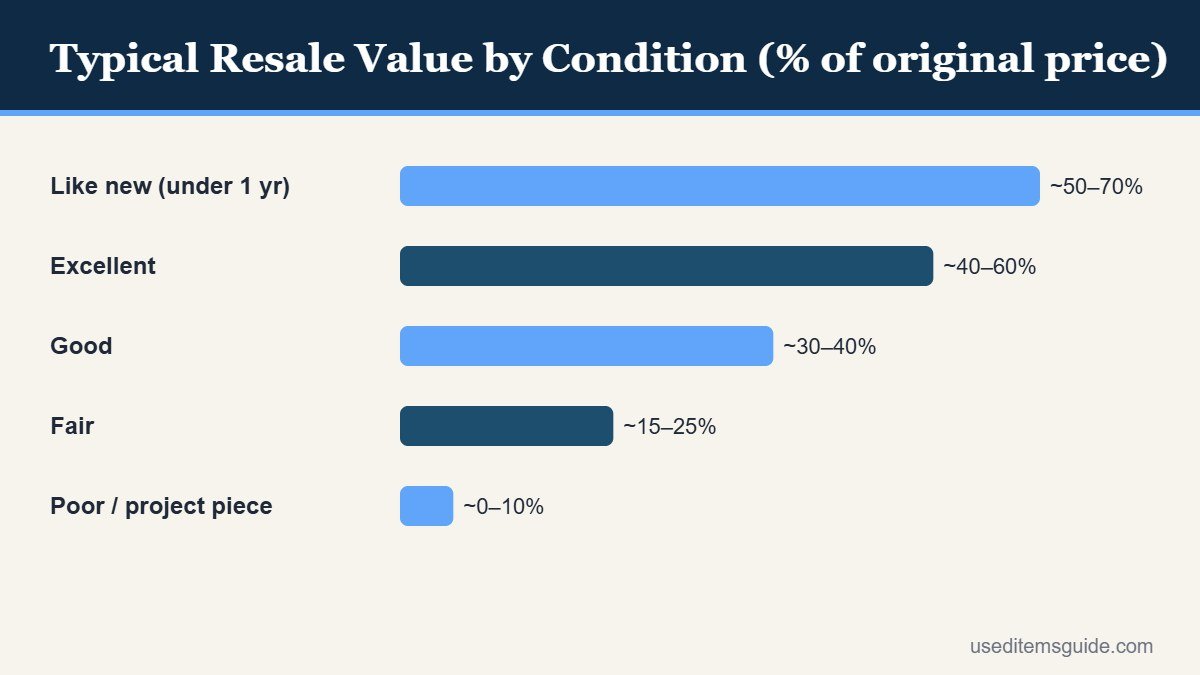
| Condition | What It Means | Typical % of Original Price |
|---|---|---|
| Like new | Under about a year old, no visible wear, all parts, ideally in a smoke-free and pet-free home | ≈ 50%–70% |
| Excellent | Minimal wear, no stains or damage, fully functional | ≈ 40%–60% |
| Good | Normal light wear, maybe minor scratches or slight fading | ≈ 30%–40% |
| Fair | Visible wear, scuffs, small stains, may need minor repair | ≈ 15%–25% |
| Poor | Broken parts, heavy stains, odors, or needs major work | ≈ 0%–10% (often better to donate or give away) |
These are starting ranges, not guarantees. A three-year-old West Elm sofa in excellent shape might fetch close to 50% in a big city, while a particleboard bookcase in the same condition might struggle to get 25% anywhere.
5 Factors That Push the Price Up or Down
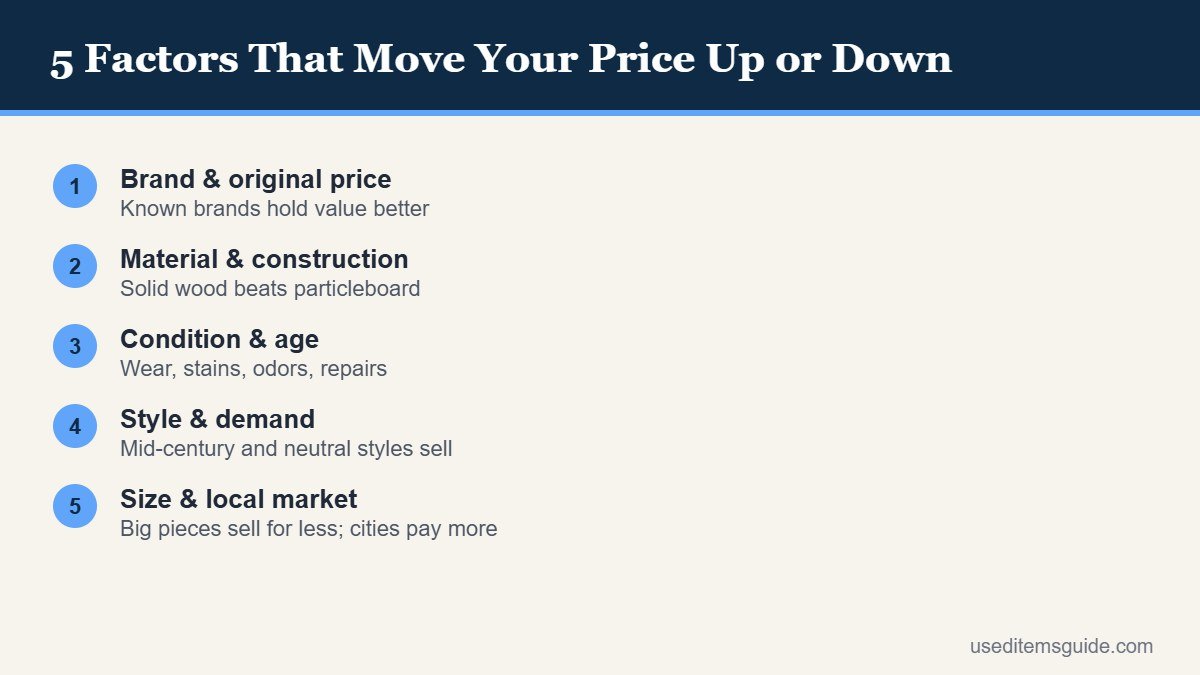
1. Brand and Original Price
Brand recognition is a shortcut for quality. Furniture from Restoration Hardware, Pottery Barn, West Elm, Crate & Barrel, Room & Board, Ethan Allen, Article, Herman Miller and similar names holds value better because buyers can look up the retail price and see the deal. Unbranded or budget furniture depreciates fastest. Adjustment: add roughly 5%–15% for strong brands; subtract a similar amount for budget pieces.
2. Material and Construction
Solid hardwood, dovetail drawer joints, kiln-dried frames and top-grain leather signal quality and longevity. Particleboard and MDF pieces lose value quickly, especially if they’ve been disassembled and reassembled, which weakens the joints. Check drawers and the underside of pieces to see what you have.
3. Condition and Age
Condition matters more than age for most buyers. Pay special attention to anything that buyers can’t easily fix: stains in fabric, pet scratches, smoke odor, sagging cushions, water damage and wobbly joints. Each of these can knock 10%–30% off your price or make a sale very slow.
4. Style and Demand
Some styles are consistently popular in the US resale market: mid-century modern, solid wood farmhouse, and simple neutral sofas. Heavy, dark, formal pieces like traditional dining room hutches and large entertainment centers have much lower demand today, so price them more aggressively.
5. Size and Your Local Market
Bigger pieces need trucks and helpers, which shrinks your buyer pool. Location also matters: furniture usually sells for more in large metros like New York, Los Angeles, Seattle and Washington, D.C., than in rural areas, and college towns spike in demand around move-in dates.
How to Research Comparable Sales (Comps)
The formula gets you in the ballpark. Comparable sales get you the right price. Spend 15 minutes on this and you’ll avoid the two biggest pricing mistakes.
- Search Facebook Marketplace for your item’s brand and type within about 20–40 miles. Note the asking prices, but pay most attention to items that disappeared quickly, which usually means they sold.
- Check OfferUp and Craigslist for the same search. If prices differ a lot between platforms, aim for the middle.
- Use eBay’s “Sold items” filter. This is the only major site that shows real completed prices publicly. It’s especially useful for brand-name, vintage and designer pieces.
- Look at resale sites like AptDeco, Kaiyo or Chairish for brand-name and designer pieces. Their listings show what buyers pay when pickup and delivery are handled.
- Adjust for differences. If a comparable sofa is newer, a better color, or includes an ottoman, adjust your price accordingly.
Ignore listings that have been sitting for a month or more; they’re priced too high. A good target is the lower half of what’s currently listed, especially if you want to sell within a week.
Used Furniture Pricing Examples
Here’s how the formula and comps work together in practice. Figures are illustrative examples, not quotes.
| Item | Original Price | Condition | Formula Estimate | After Comps | Suggested Listing |
|---|---|---|---|---|---|
| Mainstream-brand 3-seat sofa, 3 years old | $1,200 | Excellent (≈45%) | $540 | Similar sofas sell for $450–$550 locally | $549 (accept $475+) |
| Solid oak 6-drawer dresser, 8 years old | $900 | Good (≈35%) + solid wood bump | $360–$400 | Comps at $350–$425 | $399 |
| Budget particleboard bookcase | $120 | Good (≈30%) – budget adjustment | $25–$35 | Many listed at $20–$40 | $30 |
| Dining table + 4 chairs, mainstream brand | $1,500 | Good (≈35%) | $525 | Sets selling $400–$500 | $495 |
| Ergonomic office chair (premium brand) | $1,400 | Excellent (≈50%) | $700 | Sold comps $550–$700 | $649 |
Notice that the final price comes from the comps whenever they disagree with the formula. The market always wins.
Pricing Tips by Furniture Type
Different categories depreciate at different speeds. Use these notes to fine-tune your starting percentage.
| Furniture Type | How It Holds Value | Pricing Tip |
|---|---|---|
| Sofas & sectionals | Depreciate fast; condition and cleanliness matter most | Price toward the lower end unless it’s a known brand in excellent shape |
| Solid wood dressers & tables | Hold value well; steady demand | Highlight solid wood and dovetail joints; price toward the higher end |
| Dining sets | Moderate; sets beat singles | Price the set as a bundle; note chair count and table leaf |
| Office chairs & desks | Premium ergonomic brands hold value strongly | Use the exact model name; check eBay sold prices |
| Bed frames | Moderate; size matters (queen is most in demand) | Put the size in the title; include hardware |
| Particleboard/flat-pack | Depreciate fastest, especially once moved | Price low for a quick sale; IKEA items may qualify for buyback |
| Outdoor furniture | Seasonal; peaks in spring and early summer | List in spring; price lower in fall and winter |
Sofas Deserve Extra Care
Upholstered pieces are the hardest to price because buyers worry about things they can’t see in photos: odors, allergens, bedbugs and hidden stains. If your sofa is from a smoke-free, pet-free home, say so clearly. Including the fabric type, the cushion fill (foam, down blend) and whether covers are removable helps justify a higher price. If your sofa has pet damage or stains, price it as “fair” condition even if the frame is solid.
Seasonality Changes Prices
Demand for furniture rises in late spring and summer, when many Americans move, and again in late August for college move-ins. If you can wait, listing during these peaks lets you price a little higher. In slower months, price closer to the bottom of your range or be prepared to wait longer.
Local Demand Matters
The same dresser might sell for $350 in a big city and $200 in a small town. Always anchor your price to listings within driving distance, not national averages.
Pricing Vintage, Antique and Designer Furniture
Vintage and antique pieces don’t follow the depreciation curve. A 1960s Danish teak sideboard or an authentic designer chair can be worth more than its original price. Here’s how to approach them:
- Identify it. Look for maker’s marks, labels, stamps and model numbers under seats, inside drawers and on the back.
- Check sold prices on eBay, Chairish, 1stDibs and auction-results sites like LiveAuctioneers.
- Beware of reproductions. Many famous designs have been widely copied. Authentic pieces usually have labels, documentation or construction details that replicas lack.
- Don’t refinish before selling. Collectors often prefer original finish; stripping or painting can reduce value significantly.
- Consider an appraisal for pieces you suspect are worth more than about $1,000. A local antique dealer or certified appraiser can confirm authenticity and value.
Our guides on finding the value of collectibles and where to sell vintage items go deeper on research and selling.
Pricing Strategy: Negotiation, Bundles and Price Drops
Leave Room to Negotiate
On local marketplaces, almost everyone negotiates. If your minimum is $400, list at $450–$460. When someone offers $380, you can counter at $425 and settle in the middle. If you hate haggling, say “price firm” and set it closer to your minimum.
Use Charm Pricing and Filter Thresholds
Buyers often filter by “under $100,” “under $200,” and so on. A $199 dresser appears in more searches than a $210 one. Price just below these round numbers.
Bundle to Raise the Total
Selling a bedroom set, desk-and-chair combo or a whole patio set together often brings a higher total and saves you from multiple pickups. Offer the bundle at a small discount, and list the pieces separately too in case buyers only want one.
Plan Your Price Drops
Set a schedule before you list: for example, a 10% cut after 7 days with no serious interest, and another 10%–15% after 14 days. Planned cuts take emotion out of the decision. When you’re up against a moving date, price for speed from the start. Our guide on how to sell furniture fast covers timing and listing tips in more detail.
Pricing Mistakes to Avoid
- Anchoring on what you paid. Buyers don’t care what it cost new; they compare it to other used listings.
- Counting sentimental value. Your memories aren’t part of the sale.
- Ignoring delivery costs. If a buyer needs to rent a truck or hire movers, they’ll pay less. Offering help with loading can justify a higher price.
- Underpricing high-end pieces. Search the brand and model; a “used couch” might be a $4,000 designer piece.
- Never adjusting. If a listing gets lots of views but no messages, the price is the problem.
What About Consignment and Instant-Offer Prices?
If you use a consignment store or a full-service site, remember you’ll receive a share of the sale price, not the full amount. A consignment shop that sells your $600 sofa and keeps half will pay you about $300. Instant offers from services like Kaiyo are usually lower than what you might get selling yourself, in exchange for speed and convenience. For IKEA items, the IKEA Buy Back program pays store credit based on condition and original price.
Pricing Furniture for Donation and Taxes
If you donate furniture instead of selling it, the IRS says your deduction is generally limited to the item’s fair market value, which is what a willing buyer would pay for it in its current condition, not what you originally paid. IRS Publication 561 explains how to determine that value. Thrift-store and resale prices for similar items are a good reference. Learn more in our guide to free furniture donation pickup.
Frequently Asked Questions
How much should I sell my used furniture for?
A good starting point is 20%–50% of the original retail price, depending on condition, brand and material. Then compare with sold listings near you and adjust. Like-new, brand-name and solid wood pieces can command the higher end of that range.
What is the rule of thumb for pricing used furniture?
A common rule of thumb is that used furniture in good condition sells for about one-third of its original price, with excellent-condition pieces closer to half and worn pieces much lower.
How do I find out how much my furniture is worth?
Search for the same or similar item on Facebook Marketplace, OfferUp and eBay sold listings, and check brand-name resale sites like AptDeco or Chairish. For valuable antiques or designer pieces, get an appraisal.
Does used furniture hold its value?
Most mass-market furniture loses value quickly, especially particleboard. Solid wood, well-known brands, mid-century modern and authentic designer or antique pieces hold value much better and can even appreciate.
Should I price furniture higher to leave room for negotiation?
Yes. Add about 10%–15% above your minimum on local marketplaces, where buyers expect to negotiate. If you mark the listing as price firm, set it closer to your minimum.
How do I value furniture for a tax-deductible donation?
Use fair market value: what the item would sell for in its current condition. Compare thrift-store or resale prices for similar items, and see IRS Publication 561 for guidance. Items above $500 require Form 8283, and items valued over $5,000 generally need a qualified appraisal.
Final Thoughts
Pricing used furniture doesn’t have to be guesswork. Start with the condition-based percentage, adjust for brand, material, style and size, then check what similar items have actually sold for near you. Leave a little room to negotiate and plan your price drops in advance, and you’ll sell faster without leaving money on the table.
More in this series: Where to Sell Used Furniture · How to Sell Furniture Fast · IKEA Buy Back Program · Furniture Donation Pickup
