





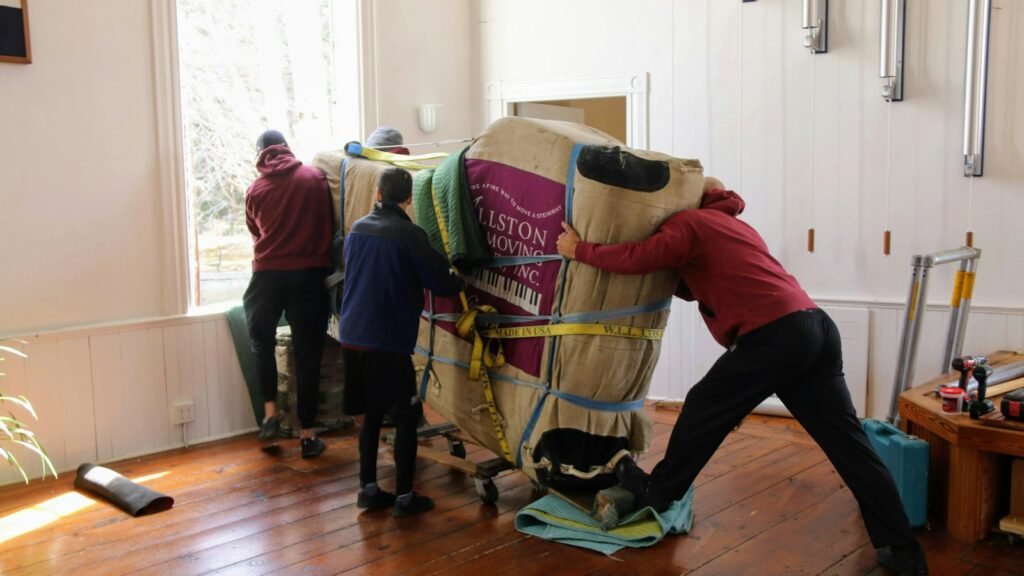
You’ve tried selling the couch. You dropped the price twice. Now moving day is close and you just need it gone, ideally without renting a truck or paying a junk-removal company $150 or more. That’s where furniture donation pickup comes in. Many US charities will come to your home and collect gently used furniture for free, resell it in their thrift stores, and use the proceeds to fund housing, rehabilitation and community programs.
This guide covers the charities and services that pick up donated furniture, what they will and won’t accept, how to schedule a pickup, and how to claim a tax deduction correctly. If your furniture is still in sellable shape, check our guides on where to sell used furniture and how to sell furniture fast first.
Key Takeaways
- The Salvation Army and Habitat for Humanity ReStore are the most widely available furniture donation pickup options in the US.
- Pickup availability depends on your ZIP code and local store, so always check online or call before you plan around it.
- Most charities only accept furniture that’s clean and in good, usable condition. Mattresses and damaged upholstery are often refused.
- Paid services like ReSupply or Lugg can haul items to charity when free pickup isn’t available in your area.
- Donated furniture may be tax-deductible at fair market value if you itemize, and you need a receipt.
Table of Contents
10 Charities and Services That Offer Furniture Donation Pickup
1. The Salvation Army
The Salvation Army runs one of the largest donation pickup programs in the country. You can schedule online by entering your ZIP code at SATruck.org or by calling 1-800-SA-TRUCK (1-800-728-7825). Donated furniture is sold in Salvation Army Family Stores, and proceeds help fund its Adult Rehabilitation Centers.
What they take: Sofas, chairs, tables, dressers, bed frames and other household furniture in good condition, plus many other household goods. Acceptance rules vary by location. In some areas The Salvation Army uses a third-party pickup partner.
Good to know: Popular pickup dates fill up fast around the end of the month and in summer, so book a week or two ahead if you can.
2. Habitat for Humanity ReStore
Habitat ReStores are home-improvement thrift stores that sell donated furniture, appliances, cabinets and building materials, with proceeds supporting Habitat’s affordable housing work. Many ReStores offer pickup for furniture and larger items. Find your nearest ReStore on Habitat.org/restores and request a pickup through your local affiliate’s site.
What they take: Furniture, working appliances, cabinets, doors, windows, lighting, tools and building supplies. ReStore is often the best option for large items and renovation leftovers.
Good to know: Pickup is free at many locations, but some ReStores ask for a small donation to cover fuel or charge a fee in certain areas. Confirm when you book.
3. Society of St. Vincent de Paul
St. Vincent de Paul is a Catholic charity with thrift stores and local councils across the US. Many locations pick up furniture and use it to furnish homes for families in need or sell it to fund assistance programs. Services are run locally, so search for “St. Vincent de Paul furniture pickup” plus your city.
4. Furniture Bank Network Members
Furniture banks give donated furniture directly to families moving out of homelessness, escaping domestic violence or resettling as refugees. Many US cities have one (for example, Chicago Furniture Bank). Some charge a pickup fee to cover their trucks and staff, but your donation goes straight to a family rather than a store. Search the Furniture Bank Network directory to find one near you.
5. Goodwill
Goodwill accepts furniture at many of its stores and donation centers, though pickup service varies by regional Goodwill organization. Some regions offer scheduled pickups for large items; others are drop-off only. Check your local Goodwill’s website.
6. Vietnam Veterans of America (PickUpPlease)
VVA’s PickUpPlease program collects household goods to fund veterans’ programs. It focuses on smaller household items, clothing and some small furniture rather than large pieces, so check the accepted-items list before booking.
7. AMVETS
AMVETS thrift stores and pickup services support US veterans. Pickup availability and accepted items vary by region; some areas accept furniture while others focus on clothing and household goods.
8. GreenDrop
GreenDrop operates donation centers in several Eastern and Mid-Atlantic states and raises funds for organizations such as the American Red Cross, the Military Order of the Purple Heart, the National Federation of the Blind and the Society of St. Vincent de Paul of Philadelphia. Check its site for whether furniture pickup is offered in your area.
9. Local Churches, Shelters and Refugee Resettlement Agencies
Smaller local organizations often need furniture more urgently than large chains. Women’s shelters, transitional housing programs and refugee resettlement agencies sometimes pick up items directly. Call first; they usually have specific needs such as beds, dining tables or dressers.
10. Paid Pickup Services That Deliver to Charity
If no charity can pick up from your address, services such as ReSupply, Lugg and some junk removal companies will haul your items and deliver usable pieces to partner charities for a fee. This is usually cheaper and greener than paying for a dumpster.
Furniture Donation Pickup Comparison
| Organization | Pickup Available? | Best For | How to Schedule |
|---|---|---|---|
| The Salvation Army | Yes, in many areas | Most household furniture | SATruck.org or 1-800-SA-TRUCK |
| Habitat for Humanity ReStore | Yes, at many stores (some ask for a fee) | Large furniture, appliances, building materials | Local ReStore website or phone |
| St. Vincent de Paul | Varies by local council | Furniture that helps local families | Local SVdP store or council |
| Furniture banks | Often, sometimes for a fee | Beds, tables, dressers for families in need | Local furniture bank |
| Goodwill | Varies by region | Smaller furniture, drop-off | Local Goodwill website |
| VVA PickUpPlease | Yes, in served areas | Small household items | PickUpPlease website |
| AMVETS | Varies by region | Household goods | Local AMVETS site |
| GreenDrop | Select areas | Household items | GreenDrop website |
| Local shelters/agencies | Sometimes | Specific needs (beds, tables) | Call directly |
| ReSupply / Lugg (paid) | Yes, for a fee | When free pickup isn’t available | Book online |

What Furniture Do Charities Accept?
Charities need furniture they can resell or give to a family immediately. They don’t have the budget to repair, clean or dispose of damaged items, which is why drivers sometimes refuse items at the door.
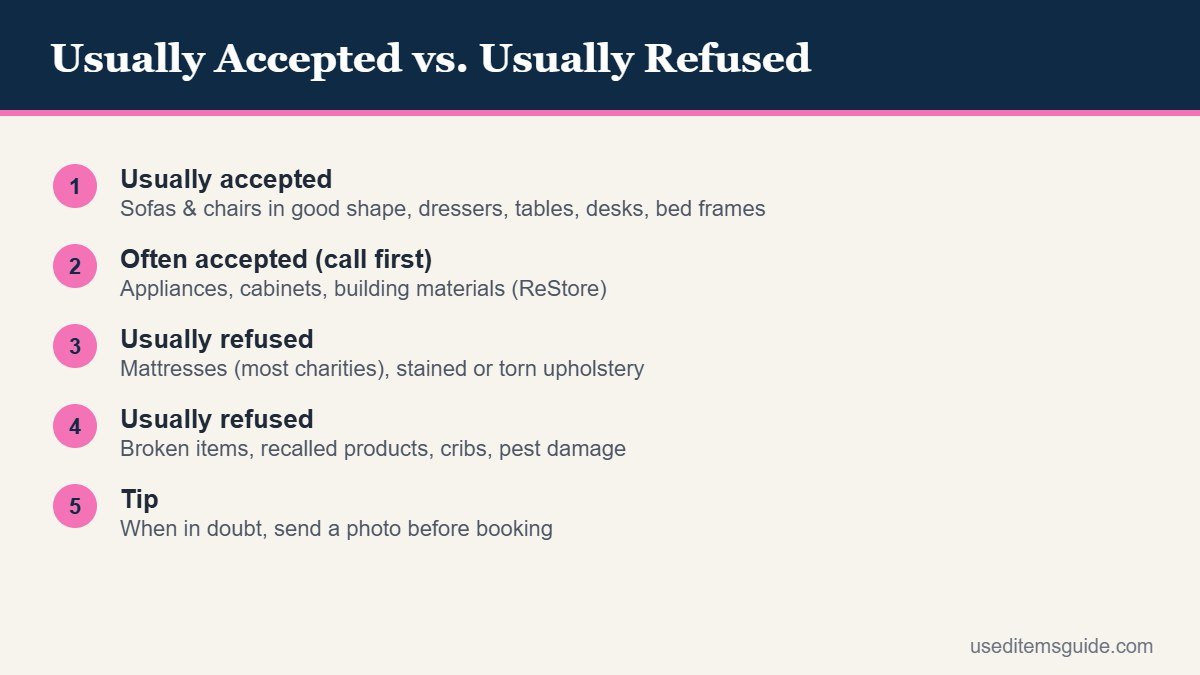
Usually Accepted
- Sofas, loveseats and armchairs with no rips, stains, odors or pet damage
- Dressers, chests, nightstands and armoires with all drawers working
- Dining tables and chairs, coffee tables and end tables
- Desks, bookcases and filing cabinets
- Bed frames and headboards (with hardware)
- Working appliances and building materials (mainly at Habitat ReStore)
Usually Refused
- Mattresses and box springs: many charities don’t accept them because of hygiene rules and disposal costs. Some furniture banks and specific stores do accept new or like-new mattresses, so ask.
- Upholstered furniture with stains, tears, odors or pet damage
- Broken furniture or items missing parts
- Recalled products, drop-side cribs and older children’s furniture that doesn’t meet current safety standards
- Anything with signs of bedbugs or other pests
- Very large or built-in pieces like entertainment walls, waterbeds or sleeper sofas in some areas
Tip: Take clear photos before you schedule and send them if the charity asks. It saves a wasted trip.
How to Schedule a Furniture Donation Pickup (Step by Step)
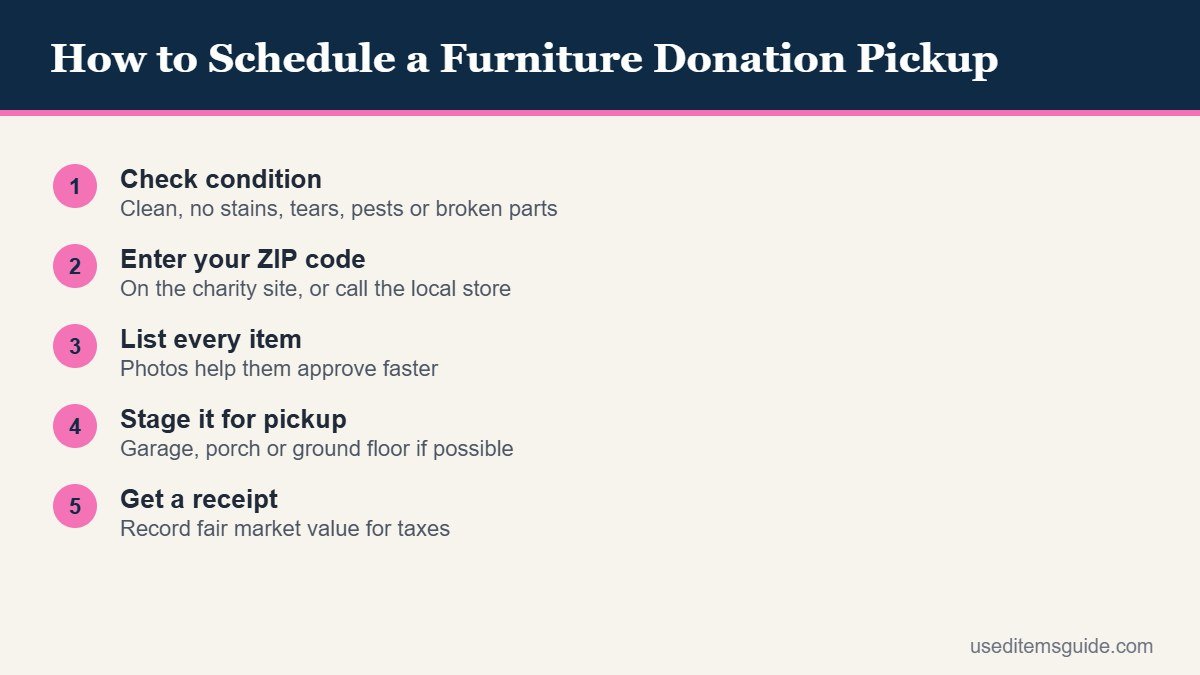
- Inspect and clean each piece. Vacuum, wipe down and check for damage. Remove personal items from drawers.
- Check availability. Enter your ZIP code on the charity’s website or call your local store. Try two or three organizations; one may have earlier dates.
- List every item accurately. Include the number and type of pieces. Drivers plan truck space and crew size from your list.
- Prepare for pickup day. Move items to the garage, porch or ground floor if you can. Some charities only pick up from outside the home or ground level; ask about stairs.
- Measure doorways and disassemble if needed. Take legs off tables and sofas if they won’t fit through doors.
- Get your receipt. Ask for a donation receipt at pickup, and photograph each item for your records.
Book early during peak moving season (May through September) and at the end of each month, when demand for pickups is highest.
Tips for a Smooth Pickup Day
A little preparation keeps drivers from leaving items behind and makes the whole process quicker:
- Confirm the day before. Many charities give a pickup window rather than an exact time. Confirm by phone or email, and ask whether someone needs to be home.
- Label everything. Put a “DONATION” sign on items you’re giving away so drivers don’t take something you meant to keep, especially if you’re also moving.
- Keep paths clear. Remove rugs, boxes and anything in the way between the furniture and the truck. Protect floors and door frames if crews are carrying pieces through your home.
- Bag the hardware. Tape a bag with screws, bolts and shelf pins to the item it belongs to. Complete furniture is far more useful to the charity.
- Be ready for a refusal. Drivers may decline an item that doesn’t meet guidelines once they see it. Have a backup plan, such as a free listing or bulk trash pickup.
- Photograph items before they leave. Those photos support your fair market value if you claim a deduction.
Donating or Selling Other Household Items
Clearing out furniture usually means clearing out lots of other things too. Most of the charities above also take clothing, kitchenware and small appliances. If you’d rather earn some cash on items that hold value, these guides can help:
- Where to sell used clothes for cash
- Where to sell used baby items (including strollers and high chairs)
- Where to sell used electronics
- Where to sell used sports equipment
What If No Charity Will Pick Up Your Furniture?
- Drop it off yourself. Many thrift stores accept furniture at their loading docks, even if they don’t pick up.
- Give it away locally. Post it as free on Facebook Marketplace, Craigslist’s free section, Nextdoor or a local Buy Nothing group. Free furniture often gets claimed within hours.
- Use a paid donation hauler. ReSupply, Lugg and similar services deliver usable items to charity.
- Check IKEA Buy Back. Eligible IKEA pieces can earn store credit instead. See our guide to the IKEA Buy Back program.
- Bulk trash pickup. For truly unusable items, many cities offer scheduled bulk-item collection. Check your city or county sanitation website.
Can You Deduct Donated Furniture on Your Taxes?
Often, yes, if you itemize deductions and donate to a qualified 501(c)(3) charity. Here’s what the IRS rules generally require (this is general information, not tax advice; check with a tax professional for your situation):
- Fair market value (FMV): You can generally deduct the item’s fair market value, meaning what a willing buyer would pay for it in its current condition, not what you paid. IRS Publication 561 explains how to determine value.
- Good used condition: Household items generally need to be in good used condition or better to be deductible.
- Receipts: Get a written acknowledgment from the charity, and keep your own list of items, condition and estimated values with photos.
- Over $500: If your total noncash deduction is more than $500, you must file Form 8283.
- Over $5,000: For an item or group of similar items valued at more than $5,000, you generally need a qualified appraisal.
To estimate FMV, look at what similar items sell for in thrift stores or on local marketplaces. Our used furniture pricing guide can help. Charities themselves usually leave the value blank on the receipt; it’s the donor’s responsibility to determine it.
Donate or Sell? A Quick Way to Decide
| Choose Donation If… | Choose Selling If… |
|---|---|
| The item is worth less than about $50 | It’s worth $75 or more and in good shape |
| You’re moving in a few days | You have at least a week or two |
| It’s large and hard for buyers to move | It’s a known brand, solid wood or vintage |
| You itemize taxes and can use the deduction | You need cash for your move |
| It hasn’t sold after two price cuts | It’s attracting messages and interest |
Frequently Asked Questions
Who will pick up donated furniture for free?
The Salvation Army and many Habitat for Humanity ReStores offer free furniture donation pickup in much of the US. St. Vincent de Paul, some Goodwill regions, AMVETS, furniture banks and local charities may also pick up, depending on your area.
Does Goodwill pick up furniture?
It depends on your region. Goodwill is made up of independent local organizations; some offer scheduled pickups for furniture, while many only accept drop-offs. Check your local Goodwill website.
Will the Salvation Army pick up a couch?
In many areas, yes, as long as the couch is clean and free of tears, stains, odors and pet damage. Schedule at SATruck.org or by calling 1-800-SA-TRUCK.
Does Habitat for Humanity pick up furniture for free?
Many ReStores pick up furniture and large items for free, but some request a small donation or charge a fee depending on the location. Contact your local ReStore to confirm.
Where can I donate a mattress?
Most large charities don’t accept used mattresses. Some furniture banks, shelters and local organizations accept new or like-new mattresses. Some states also run mattress recycling programs; check your state or city website.
How much can I deduct for donating furniture?
Generally the fair market value: what the item would sell for in its current condition. Thrift and resale prices for similar items are a good guide. Noncash deductions over $500 require Form 8283, and items valued over $5,000 generally need a qualified appraisal.
Final Thoughts
Furniture donation pickup is the easiest way to clear out pieces that won’t sell, help people in your community and possibly lower your tax bill. Start with The Salvation Army and your local Habitat ReStore, schedule early, make sure items are clean and in good shape, and always keep your receipt.
More in this series: Where to Sell Used Furniture · How to Price Used Furniture · How to Sell Furniture Fast · IKEA Buy Back Program
