






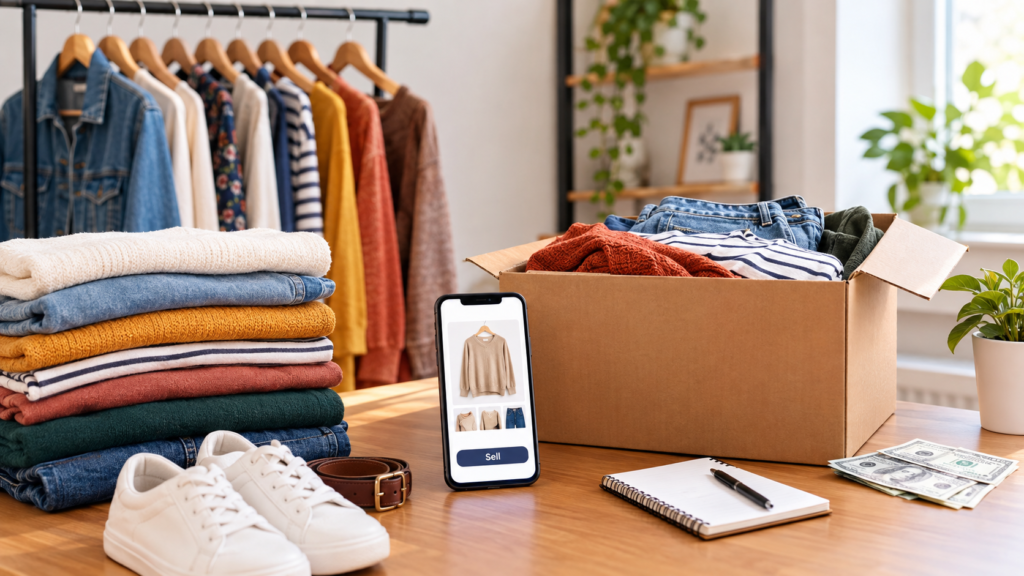
If your closet is bursting with clothes you never wear, you’re sitting on cash you haven’t collected yet. Whether it’s a coat that no longer fits, a dress you wore once, or a drawer full of your kids’ outgrown outfits, there’s a real market for gently used clothing — both online and at brick-and-mortar resale shops. If you’re looking for practical options, our guide on where to sell used clothes for cash covers popular places and methods for turning unwanted clothing into money.
In this guide, we’ll walk through the best places to sell used clothes online, the best in-person consignment and resale stores, what to do with kids’ and baby clothing specifically, how payouts and fees actually work, and the tricks experienced sellers use to get the highest possible price. By the end, you’ll have a clear game plan for turning your closet clutter into real money.
Why Selling Used Clothes Makes Sense
The average household spends a significant chunk of its budget on clothing every year, and a large share of what gets purchased ends up barely worn. Rather than letting those items sit in storage bins or get tossed in the trash, selling them accomplishes three things at once: it puts cash back in your pocket, it frees up physical space in your home, and it keeps usable clothing out of landfills by extending its life with a new owner.
You won’t get rich reselling your wardrobe — most platforms and stores pay somewhere between 10% and 50% of what an item can realistically resell for, and some take an even bigger cut. But for clothes you’re not wearing anyway, any amount of cash is better than nothing, and the process has become dramatically easier over the past several years thanks to resale apps that handle photography, shipping, and even pricing on your behalf.
Where to Sell Used Clothes Online
Online resale is usually the better option if you want to reach the widest possible pool of buyers, don’t mind a little bit of listing work, and want to hold onto a bigger share of the sale price. Here are the platforms worth your time.
1. Poshmark
Poshmark remains one of the most popular resale apps for a reason: it’s simple to use and has a large, engaged community of buyers. You create a seller profile, photograph your items, write a short description, and set a price. Once something sells, Poshmark emails you a prepaid shipping label, so you just need to pack the item and drop it off.
Poshmark charges a flat $2.95 fee on sales under $15 and takes 20% of anything sold above that threshold. It accepts a wide range of brands, from mall staples like H&M and Target to luxury names like Louis Vuitton, which makes it one of the more flexible platforms for a typical closet clean-out. Sellers who list more items — five to ten or more — tend to get noticed more often, since the algorithm favors active closets.
2. ThredUp
ThredUp is built for people who want to do as little work as possible. Instead of photographing and listing every item yourself, you request a “Clean Out Kit,” fill the bag with clothes, and mail it back using the provided label. ThredUp’s team inspects everything, decides what’s sellable, photographs it, prices it, and lists it for you.
The tradeoff for that convenience is a smaller cut of the sale and a slower payout — the whole cycle, from mailing your bag to getting paid, can take weeks. Payouts range from as little as a few percent on lower-priced items up to around 80% on higher-value pieces, and unaccepted items are typically recycled or donated unless you pay to have them returned. If your priority is convenience over maximizing every dollar, ThredUp is hard to beat.
3. Depop
Depop leans younger and trendier, with a user base concentrated among teens and young adults who treat the app almost like a mix of Instagram and a marketplace. Photography style matters a lot here — sellers who style their items well and post frequently tend to do best.
Listing is free, and Depop charges a transaction fee of roughly 3–10% depending on your account type, plus a small flat fee per sale. You can choose your own shipping method or use Depop’s built-in label option. If your wardrobe leans streetwear, Y2K, or vintage, Depop’s audience is likely to respond well to it.
4. Mercari
Mercari is a general marketplace, but clothing is one of its most active categories. Selling is entirely self-service: you take your own photos, write your own listing, and set your own price — it can help to browse similar sold listings first to price competitively.
Mercari charges a flat 10% selling fee. You can ship on your own or use a prepaid label through the app, and carriers like USPS, UPS, and FedEx will even pick packages up from your doorstep. Sellers who opt into Instant Pay can access their earnings almost immediately after a buyer confirms the item.
5. Vinted
Vinted stands out because it charges sellers absolutely nothing — no listing fee, no commission. Instead, buyers pay a small “buyer protection” fee on top of the purchase price. If your goal is to keep 100% of your sale price, Vinted is one of the only mainstream platforms that delivers on that.
You can upload up to 20 photos per listing, and more photos generally lead to faster sales. It’s a strong option for everyday clothing as well as vintage pieces.
6. Vestiaire Collective and The RealReal
If your closet includes designer or luxury pieces — think Chanel, Gucci, or Louis Vuitton — Vestiaire Collective and The RealReal are worth a dedicated look. Both platforms authenticate every item before it’s listed, which builds buyer trust and typically results in higher sale prices for genuine luxury goods.
Vestiaire Collective charges a flat fee on lower-priced items and roughly 12% on mid-range sales, plus a small payment processing fee. The RealReal’s commission varies by category and sale price, with categories like handbags, watches, and men’s sneakers generally paying out the best percentage. Both companies handle authentication, photography, and listing once your item is accepted, which is a major time-saver if you have a handful of high-value pieces rather than a whole closet to sell.
7. eBay and Facebook Marketplace
The two general-purpose giants still hold their own for clothing. eBay charges around 15% on most clothing sales (less on higher-priced items), gives you full control over pricing and listing format, and has a massive built-in audience actively searching for specific brands and styles.
Facebook Marketplace is a strong choice if you’d rather sell locally and skip shipping altogether — arrange a cash pickup and there’s no fee at all. Sell through Facebook’s checkout instead, and a roughly 10% selling fee applies. Marketplace tends to work best for bundles (a bag of kids’ clothes, a box of winter coats) rather than single high-end pieces.
8. Niche Marketplaces Worth Knowing
A handful of specialized platforms cater to specific niches and can outperform general marketplaces for the right kind of item:
- Grailed focuses on men’s streetwear and designer fashion.
- Kidizen is dedicated entirely to children’s and maternity clothing — more on that below.
- Gear Trade specializes in outdoor and technical apparel like hiking, camping, and ski gear.
- Queenly is built specifically for formalwear: prom dresses, bridal gowns, and pageant wear.
If a large chunk of what you’re selling fits one of these categories, a niche platform’s audience is already primed to buy exactly what you have, which often means a faster sale and a better price than a general marketplace.
Where to Sell Used Clothes in Person

Not everyone wants to photograph, list, ship, and wait. If you’d rather walk in, hand over a bag of clothes, and walk out with cash the same day, brick-and-mortar resale stores are the better path — even if the payout percentage is usually lower than online resale.
Buffalo Exchange
Buffalo Exchange has been buying and selling used clothing since the 1970s and accepts a wide range of styles, from vintage to activewear to plus sizes. Bring your items and an ID to any location, and staff will sort through what they want on the spot. You’ll typically walk out with cash equal to roughly a quarter of what they’ll resell the item for, or a higher percentage in store credit.
Plato’s Closet
Plato’s Closet targets teens and young adults and focuses on current, trend-driven brands — think Nike, American Eagle, and Free People. With hundreds of locations across North America, it’s one of the most accessible options if you’re clearing out a younger family member’s closet.
Clothes Mentor
Clothes Mentor is the go-to chain for women’s clothing, covering a wide size range and buying designer names alongside more mainstream brands. Like most resale chains, you’re paid cash on the spot once an associate reviews your items — usually within 20–30 minutes.
Uptown Cheapskate and Crossroads Trading
Both chains skew toward trendier, younger fashion. Uptown Cheapskate offers instant cash with a bonus if you opt for store credit instead, while Crossroads Trading pays out in cash or store credit depending on the item and location. Checking each store’s “what we’re buying” list online before you go can save you a wasted trip.
Once Upon a Child
For parents, Once Upon a Child is worth a special mention — it buys not just kids’ clothing but strollers, cribs, toys, and other baby gear, all for cash on the spot. If you’re managing a household with young kids and constantly cycling through outgrown sizes, it’s one of the most convenient resale options available. For a deeper look at everything you can offload from a nursery or playroom — not just clothes — see our guide to used baby items.
Local Consignment Shops
Don’t overlook independent consignment boutiques in your area. They typically don’t pay upfront — you get a percentage once the item actually sells — but they can be a good fit for unique or high-quality pieces that a chain store might pass on. Call ahead to ask what they’re currently looking for before hauling in a full bag.
Selling Kids’ and Baby Clothes: A Category of Its Own
Children outgrow clothes so quickly that many kids’ items are barely worn before they’re too small. That makes kids’ and baby clothing one of the easiest resale categories to work with — the supply is constant, the demand from other parents is steady, and turnaround tends to be quick.
Kidizen is built specifically for this market and lets you either manage your own “storefront” or hand items off to a personal seller who lists on your behalf. Once Upon a Child, mentioned above, is the strongest in-person option, and it buys well beyond clothing — furniture, strollers, and toys included. If you’re regularly cycling through baby gear as your child grows, it’s worth building a relationship with your local store and bringing items in every season rather than letting them pile up. Our full used baby items category breaks down more options specifically for cribs, strollers, and other nursery gear that doesn’t fit neatly into a “clothing” platform.
How Payouts and Fees Actually Work
One of the most confusing parts of reselling clothes is understanding what you’ll actually walk away with. Here’s the general pattern across most platforms and stores:
- Consignment-based platforms (ThredUp, The RealReal, Vestiaire Collective, local consignment shops) pay you a percentage of the sale price only after the item sells, and that percentage typically increases the more expensive the item is.
- Flat or tiered commission platforms (Poshmark, Mercari, Depop, eBay) charge a fixed percentage or flat fee regardless of what type of item you’re selling, and you set your own price.
- Zero-commission platforms (Vinted) shift the fee to the buyer instead of the seller.
- In-person resale stores almost always pay a lower percentage — often 25% to 50% of resale value — but they pay immediately, in cash, with no waiting for a sale to happen.
Payout methods vary too. Most online platforms offer direct deposit, PayPal, or in-app digital wallets, and many also let you take store credit instead of cash — usually at a better rate than the cash payout, since it keeps your money inside their ecosystem. If you’d rather convert a payout into a gift card for somewhere you actually shop, it’s worth knowing what major retailers do and don’t support — our breakdowns of whether Walmart sells Amazon gift cards and whether Target sells Amazon gift cards are useful reads if you’re trying to figure out how to spend resale cash or credit most efficiently.
How to Get the Most Money for Your Used Clothes
Whichever platform or store you choose, a handful of habits consistently make the difference between a disappointing payout and a genuinely good one.
Take Clear, Well-Lit Photos
On any online platform, photos do most of the selling. Use natural light where possible, photograph items from multiple angles, and include close-ups of any tags, unique details, or flaws. Blurry or dark photos are one of the most common reasons listings get scrolled past.
Write Honest, Detailed Descriptions
Buyers can’t touch or try on the item, so give them everything they need: exact size, brand, measurements (especially for anything that runs small or large), material, and an honest description of condition. Being upfront about a small flaw builds trust and avoids returns or disputes later.
Only List Items in Genuinely Good Condition
Stains, pet hair, strong odors, and visible wear will get an item rejected outright by most consignment stores and will hurt your seller rating on marketplace apps. If something is too worn to resell, consider textile recycling instead of trying to list it.
Price Competitively
Search the platform for similar items that have already sold and price accordingly. Overpricing means your listing sits untouched; underpricing leaves money on the table. Many apps show recently sold prices for comparable items — use that data rather than guessing.
Sell Seasonally
Winter coats sell for more in October than in June. List swimwear in spring, not January. If you sell in person, brands like Buffalo Exchange recommend bringing clothes in roughly every three months so what you’re offering always matches the current season’s demand.
Match the Platform to the Item
Sending outdoor gear to a general clothing platform, or a luxury handbag to a teen-focused resale store, means fewer interested buyers and a lower price. Use niche platforms (Gear Trade for outdoor gear, Kidizen for kids’ items, Vestiaire Collective or The RealReal for luxury) whenever your inventory fits one of these categories — you’ll typically see both faster sales and better prices.
List in Volume
A single item rarely attracts much attention on a crowded marketplace. Sellers with five, ten, or more active listings tend to get discovered more often simply because they show up more frequently in search and browse results. If you’re going to put in the effort to photograph and list, batch several items together in one sitting.
Beyond Clothes: Other Things Worth Selling From Around the House
Once you’ve cleared out your closet, it’s worth applying the same mindset to the rest of your home. Plenty of other categories have just as strong a resale market as clothing, sometimes stronger.
Electronics. Old phones, tablets, laptops, and gaming consoles almost always have resale value, even if they’re a few generations old or have minor cosmetic wear. Our guide on where to sell old electronics covers the best trade-in programs and marketplaces so you’re not letting a drawer full of outdated tech go to waste.
Outdoor furniture. Patio sets, outdoor sofas, and other exterior furniture hold value particularly well in spring and summer, when demand from buyers setting up their own outdoor spaces peaks. Check out our roundup of the best places to sell outdoor furniture before you consider putting a patio set out on the curb.
Collectibles. Trading cards, coins, vintage toys, comic books, and other collectible categories often sell for far more than people expect, especially through specialized marketplaces and dealer networks rather than general resale apps. If you’ve got a box of collectibles gathering dust, our guide to where to sell collectibles in the US walks through the best-paying options by category.
Treating a full decluttering project as one connected effort — clothes, electronics, furniture, and collectibles all at once — tends to be far more motivating (and profitable) than tackling your closet in isolation and never getting around to the rest.
Common Questions About Selling Used Clothes
How much money can you actually expect to make?
It depends heavily on the brand, condition, and category of what you’re selling, but as a rough benchmark, most platforms and stores pay somewhere between 10% and 50% of an item’s realistic resale value. A closet full of fast-fashion basics might bring in $30–$80 total, while a handful of designer pieces sold through an authenticated platform like The RealReal or Vestiaire Collective could bring in several hundred dollars from just a few items. Treat clothing resale as a way to recover some value from things you already own rather than as a primary income source.
Is it better to sell online or in person?
It’s less about which is objectively “better” and more about what you’re optimizing for. Online platforms almost always pay a higher percentage of resale value because there’s no store overhead to cover, but you’ll wait longer for a sale and need to handle photography, listing, and shipping. In-person resale stores pay less, but you get cash immediately and avoid any of the online listing work entirely. Many experienced sellers use both — taking higher-value or brand-name pieces online, and bringing everyday items to a local resale store for same-day cash.
What should you do with clothes that don’t sell or get rejected?
Items that are too worn, stained, or out of season for resale still have options. Many resale stores and consignment shops offer store-only donation bins, and several online platforms (ThredUp among them) will responsibly recycle or donate anything they can’t list rather than sending it back to you. H&M, The North Face, and a handful of other retailers also run in-store textile take-back programs that sometimes offer a small discount coupon in exchange, even for damaged clothing that can’t be resold.
Do you have to pay taxes on money made from selling used clothes?
For most casual sellers clearing out a closet, occasional resale income from personal items generally isn’t treated as taxable business income, since you’re typically selling items for less than you originally paid for them. That said, tax rules around online marketplace sales have shifted in recent years, and some platforms are required to issue tax forms once your sales cross a certain dollar threshold in a calendar year. If you’re selling in meaningful volume or turning resale into a repeat side hustle, it’s worth checking current IRS guidance or speaking with a tax professional rather than guessing.
How long does it typically take to get paid?
This varies widely by platform. Instant-pay options on apps like Mercari and Depop can put money in your account within minutes of a completed sale. Standard direct deposit or PayPal payouts on most marketplaces usually take a few business days. Consignment-style platforms like ThredUp or The RealReal can take anywhere from a few weeks to over a month from the time you ship your box to the time an item actually sells and pays out, since your items have to be received, inspected, listed, and then found by a buyer. In-person resale stores remain the fastest option by far — you’re paid in cash before you even leave the store.
What’s the single biggest mistake sellers make?
Sending everything to one platform regardless of what it is. A box that mixes designer handbags, everyday t-shirts, kids’ outgrown outfits, and hiking gear will perform worse split across those categories on a single general marketplace than it would if each category went to the platform built for it — luxury pieces to Vestiaire Collective or The RealReal, kids’ items to Kidizen or Once Upon a Child, outdoor gear to Gear Trade, and everyday basics to Poshmark, Mercari, or Vinted. Matching the item to the right audience is consistently the difference between a listing that sells in days and one that sits untouched for months.
Final Thoughts
Selling used clothes isn’t a get-rich strategy, but it’s one of the easiest ways to turn things you’re not using into real cash while making room in your closet and keeping wearable clothing in circulation instead of a landfill. The right platform depends on what you’re selling: general marketplaces like Poshmark, Mercari, and Vinted work well for everyday clothing; niche platforms like Vestiaire Collective, Gear Trade, and Kidizen outperform for luxury, outdoor gear, and kids’ items respectively; and in-person chains like Buffalo Exchange, Plato’s Closet, and Once Upon a Child are unbeatable when you want cash the same day.
Whichever route you choose, the fundamentals stay the same — clean, well-photographed, honestly described, seasonally timed listings consistently earn more than rushed ones. Start with the platform that best matches what’s actually in your closet, and don’t stop at clothes — the same declutter-and-sell approach works just as well for electronics, furniture, and collectibles sitting elsewhere in your home. For more guides like this one, browse the full library at Used Items Guide.
